
Introduction
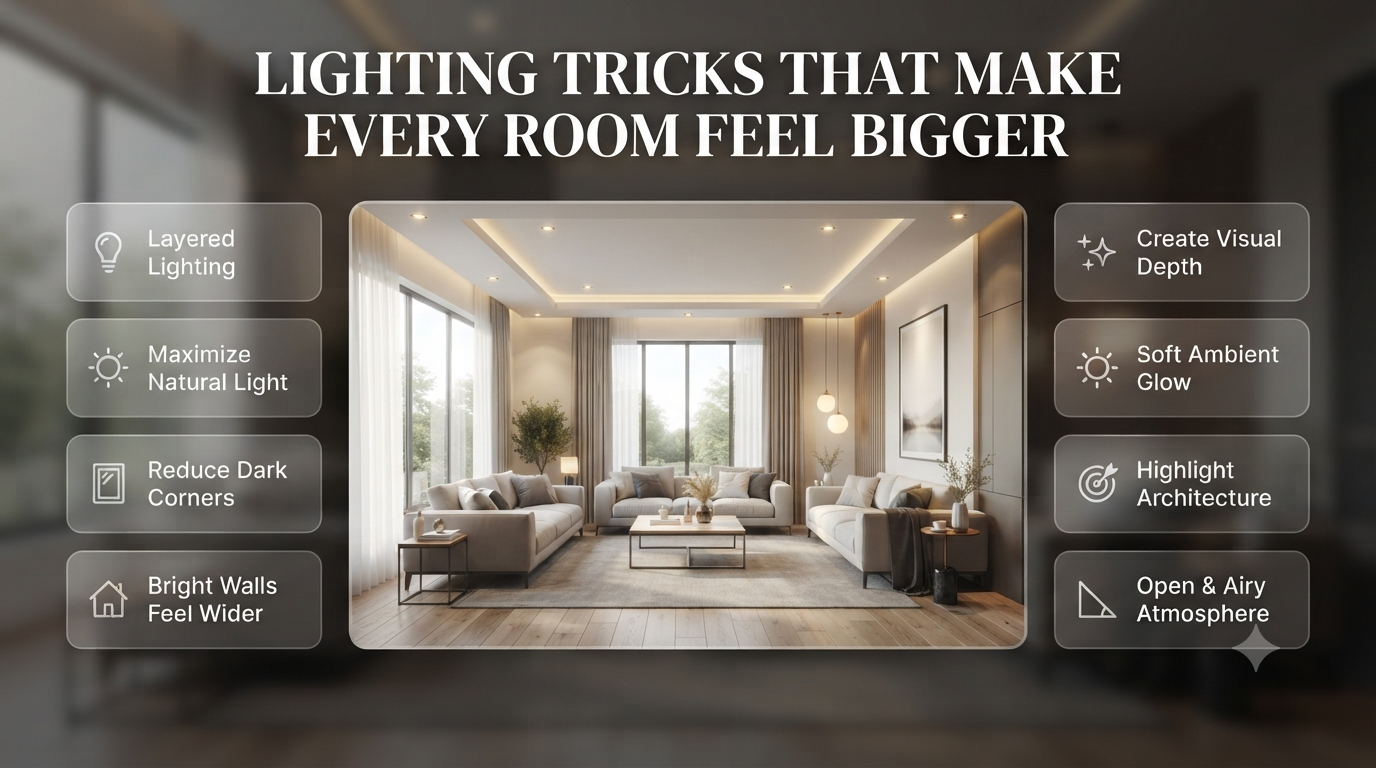
Have you ever walked into a small room that somehow felt bright, open, and surprisingly spacious? Chances are, the secret wasn’t knocking down walls or buying expensive furniture—it was smart lighting.
Many homeowners spend thousands of dollars trying to make their homes feel larger, yet overlook one of the most powerful design tools available. The right lighting can visually expand a room, highlight architectural features, reduce dark corners, and create an airy atmosphere without changing the room’s actual size.
These lighting tricks that make every room feel bigger work in apartments, condos, small houses, bedrooms, kitchens, living rooms, bathrooms, and even narrow hallways. Whether you’re decorating a new home or refreshing an older one, understanding how light influences perception can completely transform your space.
In this guide, you’ll learn professional lighting strategies, common mistakes to avoid, room-specific recommendations, and practical techniques used by interior designers to make even the smallest rooms feel significantly larger.
Why Does Lighting Make a Room Feel Bigger?
Lighting makes a room feel bigger because it reduces shadows, brightens corners, reflects off surfaces, and creates visual depth. Even light distribution helps the eye perceive a larger, more open space, while dark areas can make rooms feel smaller and more enclosed.
Lighting doesn’t physically increase square footage, but it dramatically changes how your brain interprets a space. Dark corners visually “shrink” a room because your eyes struggle to define its boundaries. Bright, evenly illuminated walls create the illusion that the room extends farther than it actually does.
Professional interior designers often focus on light before choosing furniture or décor because lighting sets the foundation for how every other element is perceived.
Some of the biggest benefits include:
- Makes ceilings appear taller
- Creates visual depth
- Eliminates cramped, shadowy corners
- Highlights architectural details
- Reflects light across the room
- Improves comfort and mood
- Enhances the appearance of colors and textures
💡 Pro Tip: Before buying new furniture, improve your lighting. Many small rooms instantly feel more spacious with better illumination alone.
How the Human Eye Perceives Room Size
Our brains constantly judge a room based on light, contrast, and visible boundaries. When light reaches every corner, your eyes can easily identify the room’s dimensions, making it feel larger.
On the other hand, uneven lighting creates patches of darkness that visually “erase” parts of the room, making it seem smaller than it is.
Several factors influence this perception:
| Lighting Factor | Effect on Room Size |
|---|---|
| Bright walls | Makes walls seem farther away |
| Dark corners | Makes space feel cramped |
| Even lighting | Creates openness |
| Reflected light | Adds visual depth |
| Warm shadows | Adds coziness but may reduce perceived size |
| Layered lighting | Enhances dimension and balance |
This is why professional designers rarely rely on a single ceiling light.
The Three Layers of Lighting Every Room Needs
The best lighting design combines ambient, task, and accent lighting. Together, these three layers eliminate harsh shadows, improve functionality, and create depth that makes rooms appear larger and more inviting.
One overhead light is rarely enough. Instead, designers use a layered approach to distribute light evenly throughout the room.
1. Ambient Lighting
Ambient lighting provides the overall illumination for a space.
Common examples include:
- Ceiling-mounted fixtures
- Recessed lights
- LED panels
- Chandeliers
- Flush-mount ceiling lights
This layer ensures the room is evenly lit without creating harsh contrasts.
2. Task Lighting
Task lighting focuses on specific activities.
Examples include:
- Reading lamps
- Desk lamps
- Under-cabinet kitchen lighting
- Vanity lights
- Bedside lamps
Task lighting improves functionality while adding another layer of brightness that reduces shadows.
3. Accent Lighting
Accent lighting highlights features and adds visual interest.
Popular choices include:
- Wall sconces
- Picture lights
- LED strip lights
- Shelf lighting
- Cabinet lighting
- Cove lighting
Accent lighting creates depth, making walls appear farther away and enhancing the room’s dimensions.
⭐ Expert Tip: Layering light at different heights—ceiling, eye level, and floor—creates a balanced environment that naturally feels larger than relying on one bright overhead fixture.
For more ideas on creating balanced interiors, explore Interior Design and Room Design.
Maximize Natural Light Before Adding Fixtures
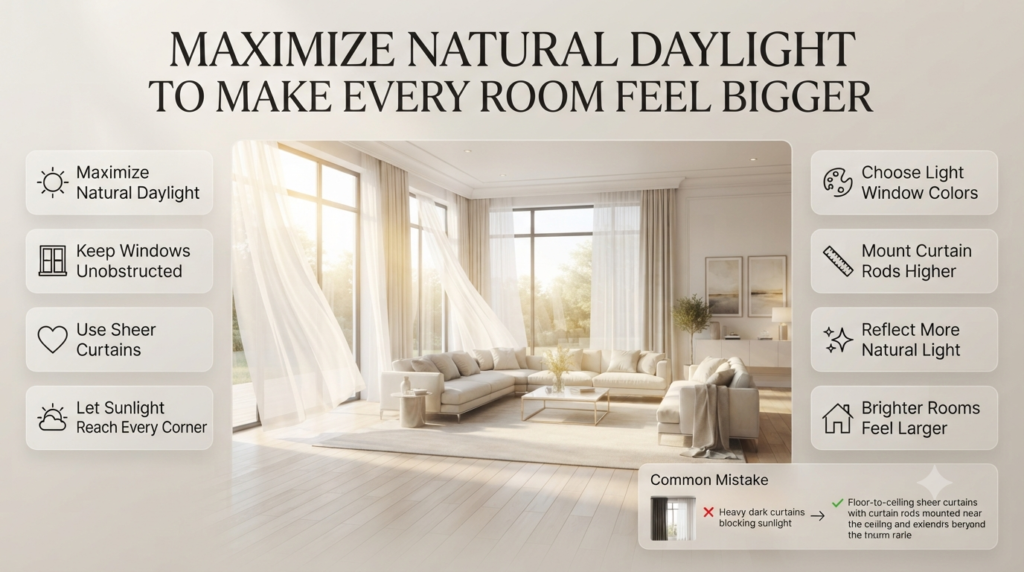
Natural daylight is the most effective way to make a room feel larger. Keep windows unobstructed, use sheer curtains, and choose reflective finishes to maximize sunlight throughout the day.
Artificial lighting should enhance—not replace—natural light whenever possible.
Here are proven ways to increase daylight:
Use Sheer Curtains
Heavy drapes absorb light and visually block windows.
Instead, choose:
- White linen curtains
- Sheer voile panels
- Light-filtering fabrics
- Ceiling-to-floor curtains
These allow sunlight to enter while maintaining privacy.
Keep Windows Clear
Avoid placing:
- Large bookcases
- Tall plants
- Bulky furniture
- Dark décor
in front of windows.
Every obstruction reduces the amount of light entering the room.
Choose Light-Colored Window Treatments
Neutral shades reflect more light than dark fabrics.
Good options include:
- White
- Ivory
- Soft gray
- Cream
- Pale beige
⚠ Common Mistake: Hanging curtains just above the window frame can make windows look smaller. Mount curtain rods closer to the ceiling and extend them beyond the window edges to create the illusion of taller, wider windows.
If you’re planning a broader makeover, you’ll find more inspiration in Home Decor and Home Improvement Tips.
Choose the Right Color Temperature
Color temperature affects how spacious a room feels. Neutral white light (around 3500K–4000K) offers a clean, balanced appearance, while warmer or cooler tones can influence mood and visual perception.
Not all white light looks the same. The Kelvin (K) rating determines whether light appears warm, neutral, or cool.
| Color Temperature | Appearance | Best Use |
|---|---|---|
| 2700K | Warm White | Bedrooms, cozy living rooms |
| 3000K | Soft White | Dining rooms, family rooms |
| 3500K | Neutral White | Multipurpose spaces |
| 4000K | Cool Neutral | Kitchens, bathrooms, offices |
| 5000K+ | Daylight | Garages, workshops, utility rooms |
For most homes, 3000K–4000K strikes the best balance between comfort and spaciousness.
Warm Light
Warm lighting creates a cozy atmosphere, making it ideal for relaxation. However, if overused in a small room, it can make the space feel more enclosed.
Neutral White
Neutral lighting closely resembles natural daylight. It reveals colors accurately, brightens surfaces evenly, and helps rooms appear open without feeling sterile.
Cool White
Cooler lighting increases brightness and clarity, making it a smart choice for kitchens, bathrooms, laundry rooms, and workspaces where visibility matters most.
📌 Quick Tip: Stick to one consistent color temperature within an open-plan area. Mixing warm and cool bulbs can create visual imbalance and make the space feel disjointed.
Why Wall Lighting Creates the Illusion of More Space
Wall lighting directs illumination outward instead of only downward, reducing harsh shadows and making walls appear farther away. This simple technique creates a greater sense of depth and openness.
Unlike ceiling lights that focus mainly on the floor, wall-mounted fixtures spread light across vertical surfaces. Since our eyes naturally follow illuminated walls, the room feels wider and taller.
Popular wall-lighting options include:
- Wall sconces
- Up-and-down lights
- Picture lights
- LED wall washers
- Recessed wall lights
These fixtures are especially effective in:
- Narrow hallways
- Small living rooms
- Compact bedrooms
- Entryways
- Home offices
Wall lighting also pairs beautifully with mirrors, artwork, and textured finishes to amplify brightness without adding clutter.
Best Ceiling Lighting Ideas That Make Every Room Feel Bigger
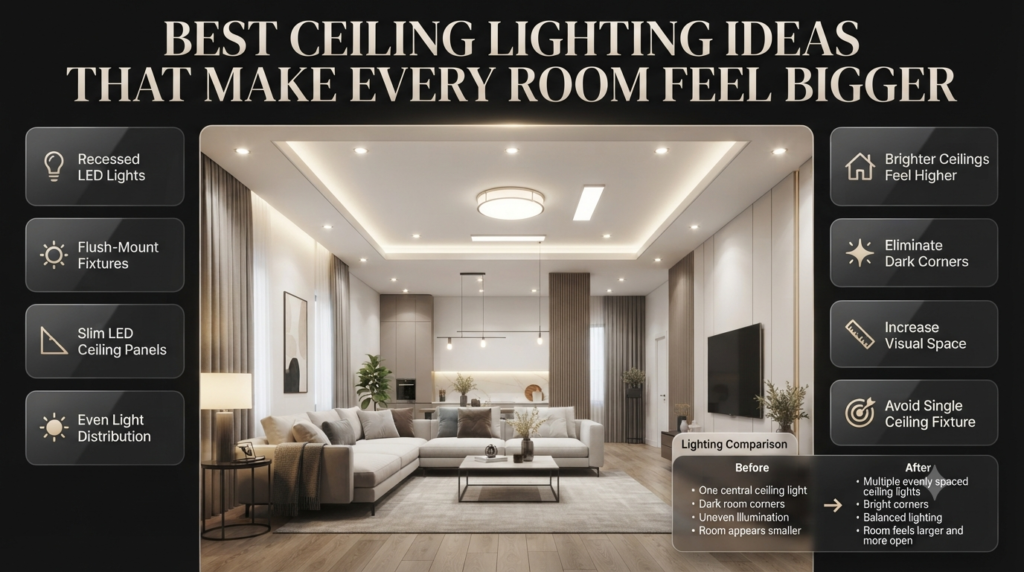
The best ceiling lighting for small rooms provides even illumination without creating harsh shadows. Recessed lights, flush-mount fixtures, slim LED panels, and strategically placed pendants distribute light evenly, making ceilings appear higher and rooms feel more spacious.
Your ceiling is often the largest uninterrupted surface in a room. How you light it has a major impact on how open the entire space feels.
Many homes rely on a single ceiling fixture in the center of the room. While this provides basic illumination, it leaves the corners darker, making the room appear smaller than it really is.
Instead, choose ceiling lighting that spreads light across the entire room.
Recessed Lighting: A Designer Favorite
Recessed lighting (also called can lights or downlights) sits flush with the ceiling, creating a clean, modern appearance without visually cluttering the room.
Why it works
- Keeps the ceiling visually uncluttered
- Creates even light distribution
- Eliminates dark corners
- Makes ceilings appear taller
- Works well in almost every room
These fixtures are especially useful for:
- Living rooms
- Kitchens
- Hallways
- Bathrooms
- Basements
- Open-plan homes
⭐ Expert Tip: Instead of placing recessed lights only around the edges of the room, create an evenly spaced layout. This prevents bright spots and shadowy areas.
Flush-Mount Ceiling Lights
If your home has lower ceilings, flush-mount fixtures are often the best choice.
Unlike hanging chandeliers, they sit close to the ceiling, leaving more visual space above eye level.
Benefits include:
- Ideal for ceilings under 8 feet
- Clean, modern appearance
- Excellent general illumination
- Minimal visual clutter
- Suitable for bedrooms and hallways
Choose fixtures with frosted diffusers to soften light and reduce glare.
Semi-Flush Fixtures for Medium-Height Ceilings
Semi-flush lights hang slightly below the ceiling while still maintaining an open look.
They’re perfect when you want decorative style without sacrificing visual space.
Best used in:
- Dining rooms
- Bedrooms
- Entryways
- Small living rooms
Avoid oversized decorative fixtures in compact rooms, as they can dominate the space.
Slim LED Ceiling Panels
Modern LED panels provide broad, even lighting while remaining almost invisible.
Advantages include:
- Energy efficient
- Ultra-thin profile
- Minimal shadows
- Bright, balanced illumination
- Long lifespan
They’re particularly effective in:
- Kitchens
- Home offices
- Laundry rooms
- Apartments
Recessed Lights vs Pendant Lights
Both lighting styles can make a room feel larger—but they serve different purposes.
| Feature | Recessed Lights | Pendant Lights |
|---|---|---|
| Makes ceiling appear higher | ⭐⭐⭐⭐⭐ | ⭐⭐⭐ |
| Even room lighting | ⭐⭐⭐⭐⭐ | ⭐⭐⭐ |
| Decorative appeal | ⭐⭐⭐ | ⭐⭐⭐⭐⭐ |
| Works in small rooms | Excellent | Good (correct size only) |
| Visual clutter | Very Low | Moderate |
| Best for | General lighting | Accent or task lighting |
Which should you choose?
Choose recessed lighting if:
- Your room is small
- Ceilings are low
- You want a minimalist look
- You need balanced illumination
Choose pendant lighting if:
- You’re highlighting an island
- Lighting a dining table
- Creating a focal point
- The room has higher ceilings
⚠ Common Mistake: Hanging oversized pendant lights in a small room often makes the ceiling feel lower and the room more crowded.
Floor Lamps vs Table Lamps
Floor lamps create vertical lines that draw the eye upward, while table lamps add layered lighting at eye level. Combining both helps eliminate shadows and gives rooms greater depth.
Layering lighting at different heights is one of the oldest interior design techniques for creating visual depth.
Floor Lamps
Floor lamps naturally lead the eye upward.
Benefits include:
- Adds height
- Brightens dark corners
- Creates vertical emphasis
- Easy to reposition
- No installation required
Tall arc lamps work especially well beside sofas.
Table Lamps
Table lamps create comfortable, localized lighting.
Ideal locations:
- Bedside tables
- Console tables
- End tables
- Office desks
- Entry tables
Rather than replacing ceiling lighting, they should complement it.
Which Is Better?
The answer is both.
Professional designers combine:
- Ceiling lighting
- Floor lamps
- Table lamps
- Accent lighting
This layered approach creates a balanced environment that feels significantly larger than relying on one light source.
📌 Quick Tip: Place a floor lamp in the darkest corner of the room. Brightening neglected corners instantly expands the perceived size of the space.
Mirror and Lighting: The Perfect Combination
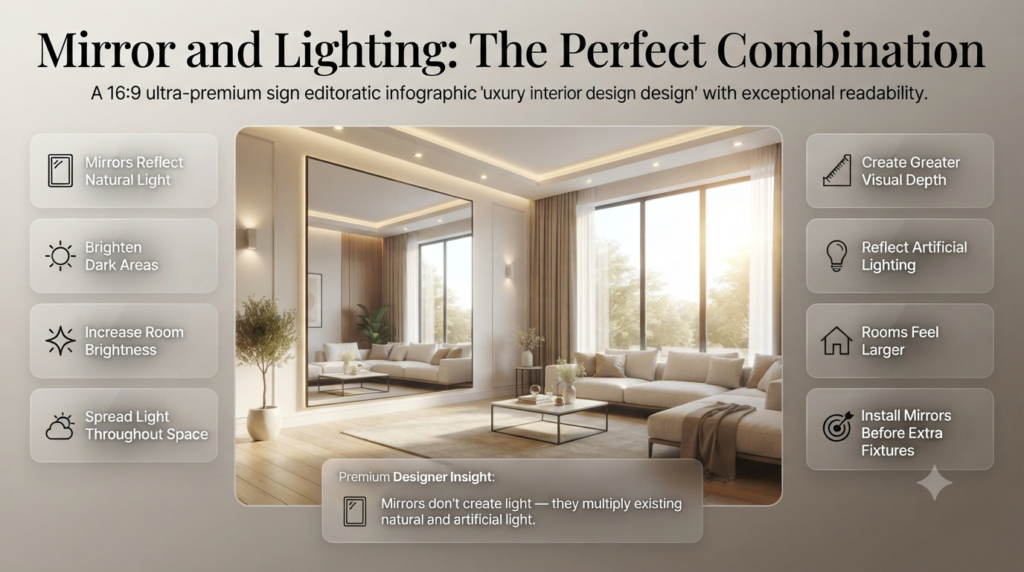
Mirrors amplify both natural and artificial light by reflecting it throughout the room. When positioned correctly, they brighten dark areas and create the illusion of greater depth.
Mirrors don’t produce light—but they multiply it.
That’s why designers often install mirrors before adding extra fixtures.
Place Mirrors Opposite Windows
This is perhaps the simplest trick in interior design.
When a mirror faces a window, it reflects daylight deeper into the room.
Benefits include:
- More natural brightness
- Wider appearance
- Greater depth
- Less dependence on artificial lighting
Pair Mirrors with Wall Sconces
Installing sconces beside a mirror creates balanced lighting while doubling the visual impact.
Perfect locations include:
- Bathrooms
- Hallways
- Entryways
- Bedrooms
Large Mirrors Create Larger Spaces
A full-length mirror reflects much more light than a small decorative mirror.
Good options include:
- Leaning mirrors
- Floor mirrors
- Oversized framed mirrors
- Mirrored closet doors
For additional decorating inspiration, browse Home Decor or discover more Furniture ideas that pair beautifully with strategic lighting.
💡 Pro Tip: Position mirrors where they’ll reflect something attractive—such as a window, artwork, or a well-lit corner—instead of reflecting clutter.
Hidden Lighting Tricks Professionals Use
Hidden LED lighting creates soft, indirect illumination that reduces harsh shadows and visually expands walls and ceilings. Because the light source remains concealed, rooms feel brighter without appearing cluttered.
Indirect lighting is one of the biggest differences between professionally designed homes and ordinary interiors.
Cove Lighting
Installed along ceiling edges, cove lighting washes the ceiling with soft light.
Benefits:
- Makes ceilings appear higher
- Creates luxurious ambiance
- Eliminates harsh shadows
- Works beautifully in living rooms and bedrooms
Under-Cabinet Lighting
A simple LED strip beneath kitchen cabinets can completely transform a workspace.
Advantages include:
- Brighter countertops
- Greater visual depth
- Improved functionality
- Modern appearance
Floating Shelf Lighting
LED strips hidden beneath shelves add subtle depth.
Excellent for displaying:
- Books
- Plants
- Decorative accessories
- Artwork
- Collectibles
Behind-TV Lighting
Bias lighting behind a television isn’t just stylish—it also reduces eye strain while making the surrounding wall appear farther away.
This technique works particularly well in modern living rooms.
Toe-Kick Lighting
Installing LED strips beneath cabinets or bathroom vanities creates the illusion that furniture is floating.
The result:
- Less visual weight
- Cleaner appearance
- More spacious feeling
⭐ Expert Tip: Choose dimmable LED strips so you can adjust brightness throughout the day. Bright light works well during daytime, while softer evening lighting creates a relaxing atmosphere.
Room-by-Room Lighting Tricks
No two rooms have the same lighting needs. The most effective approach is to match your lighting strategy to how each space is used.
| Room | Best Lighting Strategy | Why It Works |
|---|---|---|
| Living Room | Layered ceiling lights + floor lamps | Adds depth and flexibility |
| Bedroom | Warm bedside lamps + indirect ceiling lighting | Creates comfort without shrinking the room |
| Kitchen | Recessed lights + under-cabinet LEDs | Eliminates shadows on work surfaces |
| Bathroom | Vanity lights + ceiling lighting | Brightens faces and enlarges the space |
| Hallway | Wall sconces + recessed lights | Makes narrow spaces appear wider |
| Home Office | Neutral white task lighting | Reduces eye strain while improving focus |
Living Room Lighting Ideas
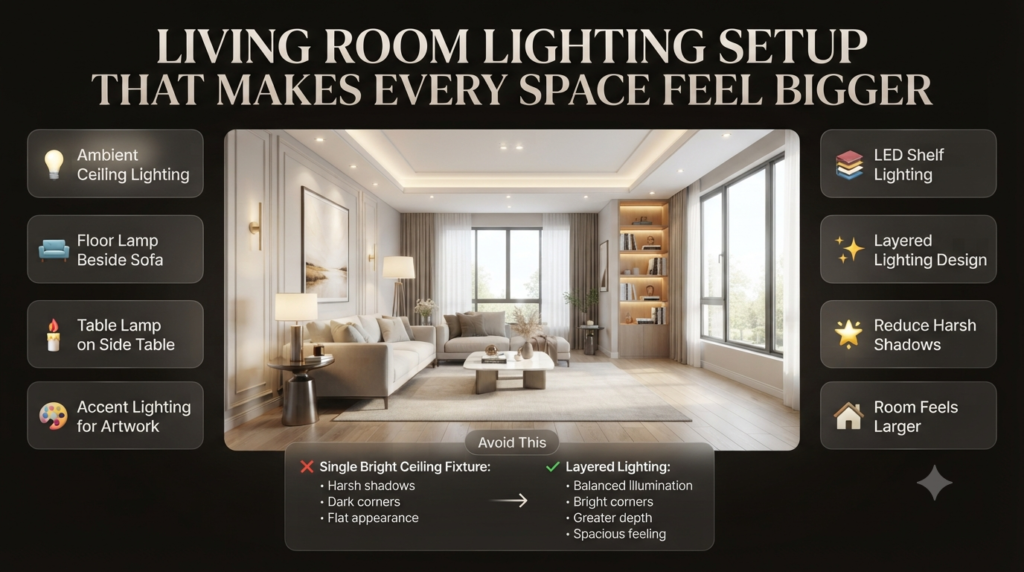
For many homes, the living room serves multiple purposes, from relaxing with family to entertaining guests.
A balanced lighting setup should include:
- Ambient ceiling lighting
- Floor lamp beside the sofa
- Table lamp on a side table
- Accent lighting for artwork
- LED shelf lighting
Avoid relying on one bright ceiling fixture, as it creates harsh shadows around the room.
Bedroom Lighting Ideas
Bedrooms should feel open yet relaxing.
A great lighting plan includes:
- Warm bedside lamps
- Soft cove lighting
- Dimmable ceiling fixture
- Closet lighting
- Reading light
Avoid bright daylight bulbs throughout the bedroom, as they can feel harsh before bedtime.
Kitchen Lighting Ideas
Kitchens benefit from layered lighting more than almost any other room.
Combine:
- Recessed ceiling lights
- Pendant lights over islands
- Under-cabinet LEDs
- Pantry lighting
- Cabinet interior lighting
The result is a brighter, cleaner space that feels larger while improving safety and functionality.
Continue reading related home improvement ideas in Room Design and explore more practical guides on the Home Improvement Tips homepage.
Lighting Ideas for Bathrooms That Feel Bigger
Bathrooms feel larger when lighting is even and shadow-free. Combine ceiling lighting with vanity lights placed on both sides of the mirror and use reflective surfaces to brighten the entire space.
Bathrooms often have limited natural light, so artificial lighting plays an even bigger role.
Best Bathroom Lighting Setup
- Recessed ceiling lights
- Vertical vanity lights beside the mirror
- LED mirror lighting
- Shower niche lighting
- Soft under-vanity LED strips
This combination eliminates shadows around the face while making the room feel cleaner and more spacious.
💡 Pro Tip: Choose moisture-rated LED fixtures with a color temperature between 3000K and 4000K for a natural, flattering look.
Lighting Tricks for Narrow Hallways
Hallways look wider when light is distributed evenly along the walls instead of relying on a single fixture. Wall sconces and recessed lights create continuous illumination that visually expands the space.
To improve a narrow hallway:
- Install evenly spaced recessed lights.
- Add wall sconces for depth.
- Use a mirror at the end of the hallway.
- Paint walls in light colors.
- Avoid bulky hanging fixtures.
These simple changes reduce the “tunnel effect” common in small corridors.
Dining Room Lighting Tips
The dining room should feel inviting without appearing cramped.
A balanced setup includes:
- A properly sized pendant or chandelier centered over the table.
- Dimmable ceiling lighting.
- Accent lighting for artwork or display cabinets.
- Warm white bulbs (around 3000K) for a comfortable atmosphere.
⚠ Common Mistake: Choosing a chandelier that’s too large for the room. Oversized fixtures can visually overwhelm a compact dining area.
Home Office Lighting for Productivity and Space
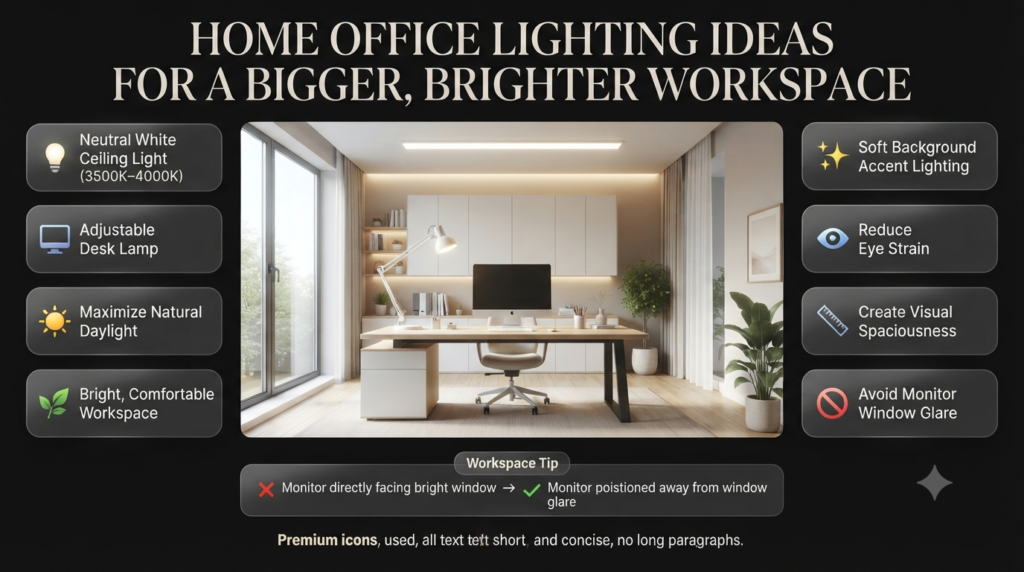
A well-lit home office feels both larger and more comfortable to work in.
For the best results, combine:
- Neutral white ceiling lighting (3500K–4000K)
- An adjustable desk lamp
- Natural daylight whenever possible
- Soft background accent lighting to reduce contrast
Avoid placing your monitor directly in front of a bright window, as glare can reduce comfort and productivity.
Common Lighting Mistakes That Make Rooms Look Smaller
Even expensive lighting can work against you if it’s used incorrectly.
1. Using Only One Ceiling Light
A single central fixture leaves corners dark, making the room feel enclosed.
Solution: Add layered lighting with lamps and accent fixtures.
2. Blocking Natural Light
Large furniture, heavy curtains, or decorative items in front of windows reduce daylight.
Solution: Keep windows as open as possible and use sheer curtains.
3. Choosing the Wrong Bulb Color
Mixing warm and cool bulbs creates an inconsistent appearance.
Solution: Use a consistent color temperature throughout each room.
4. Ignoring Dark Corners
Dark corners visually “shrink” a room.
Solution: Place floor lamps, wall sconces, or LED strips in these areas.
5. Oversized Decorative Fixtures
Large chandeliers or bulky pendants can dominate a small room.
Solution: Scale fixtures to the room’s dimensions.
6. Forgetting Dimmer Switches
Different activities require different lighting levels.
Installing dimmers gives you flexibility while improving comfort throughout the day.
⭐ Expert Tip: Great lighting isn’t always brighter—it’s more balanced. Aim for even illumination rather than maximum brightness.
Expert Interior Designer Recommendations
Professional designers often follow a few timeless principles that consistently make rooms feel larger:
- Layer ambient, task, and accent lighting.
- Highlight walls instead of only the floor.
- Brighten every corner of the room.
- Use mirrors to reflect both natural and artificial light.
- Choose light-colored lampshades to diffuse light.
- Install dimmers for flexibility.
- Keep lighting styles consistent throughout open spaces.
- Select fixtures that match the scale of the room.
- Maximize daylight before adding more fixtures.
- Replace outdated bulbs with high-quality LED lighting.
For more decorating inspiration, explore Interior Design, Room Design, Furniture, or browse the Home Page for additional home improvement guides.
How can I use lighting to make a small room feel bigger?
To make a small room feel bigger, you must eliminate shadows and draw the eyes upward and outward. Standard overhead lighting creates a pool of light in the center of the room, leaving corners dark and causing the walls to feel like they are closing in. By layering your light sources and bouncing light off reflective surfaces, you visually push the boundaries of the room. Spreading light evenly across all four corners blurs the physical edges of the space, creating an illusion of vastness.
Layer your lighting: Combine ambient (general), task (reading/cooking), and accent (decorative) lighting to create depth.
Recessed ceiling lights: Install these around the perimeter of the room to cast light down the walls, a technique called “wall washing.”
Use uplighting: Place floor lamps that direct light toward the ceiling to make low ceilings feel much taller.
Incorporate mirrors: Position lamps directly in front of or next to mirrors to double the amount of light bouncing around the room.
What type of lighting makes a dark room look brighter and larger?
The key to transforming a dark, cramped room is choosing the correct color temperature and maximizing indirect light illumination. Cool, crisp light mimics natural daylight, which instantly makes a space feel more open and airy compared to warm, yellow light that can feel cozy but restrictive. Additionally, relying on fixtures that diffuse light softly across the walls, rather than pointing a single harsh beam downward, removes the oppressive feel of dark shadows. Opt for 3000K to 4000K bulbs: This Kelvins range offers a clean white light that simulates daylight without feeling sterile.
Choose high CRI bulbs: Look for a Color Rendering Index (CRI) of 90 or higher to make colors pop and surfaces look brighter.
Utilize LED strip lights: Hide these behind TVs, under cabinets, or behind headboards to create a floating, spacious effect.
Avoid heavy lampshades: Use opaque or clear glass shades that allow light to scatter in all directions.
Where should I place lights in a small bedroom to maximize space?
In a small bedroom, floor space and surface space on nightstands are premium real estate. Placing lamps on bedside tables clutters the visual field, making the room look smaller. The professional strategy is to lift your lighting sources off the ground and tables entirely. Wall-mounted fixtures and hanging pendants draw the eye upward, emphasize vertical height, and free up surfaces, which instantly makes the bedroom feel more streamlined and spacious. Install wall sconces: Mount them on either side of the bed to replace bulky bedside table lamps.
Hang low pendant lights: Drop these from the ceiling over your nightstands to draw the eyes upward.
Add wardrobe lighting: Install motion-activated LED bars inside or above closets to eliminate dark storage corners.
Illuminate the perimeter: Keep the center of the room clear and focus light fixtures toward the boundaries of the space.
Does warm or cool lighting make a room look bigger?
Cool lighting is scientifically proven to make a room look bigger, while warm lighting makes it feel smaller. Warm light (under 3000K) emits cozy, yellow-orange tones that draw walls inward visually, creating an intimate, closed-in atmosphere. Cool light (3500K to 5000K) leans toward blue and white tones, which visually recedes. Because the human eye perceives cool tones as being further away, walls illuminated with cool light feel more distant than they actually are. Cool light recedes: Blue-white tones trick the brain into thinking walls are further apart.
Warm light advances: Yellow tones bring surfaces closer, shrinking the perceived environment.
Balance is crucial: Use cool light for daytime and task areas, but keep a hint of warmth (around 3000K) so it still feels like a home.
Match your paint: Pair cool lighting with light paint colors (whites, light grays, soft blues) to maximize the widening effect.
How do I maximize natural light to make my living room look spacious?
Natural light is the absolute best tool for expanding a room, but it must be managed correctly so it does not cause blinding glare or leave adjacent corners in deep shadow. The goal is to capture incoming sunlight and stretch it across the entire room. You can achieve this by removing physical barriers at the windows and using interior finishes that act like a mirror, catching the natural light and throwing it deep into the darker zones of the living space.
Hang sheer curtains: Replace heavy, dark drapes with translucent fabrics that let sunlight filter through completely.
Extend your curtain rods: Mount rods 6 to 12 inches outside the window frame so curtains can be pulled completely clear of the glass.
Use glossy finishes: Choose satin or semi-gloss paint and shiny decorative objects to catch and bounce natural sunlight.
Keep windows clean: Wash both sides of the glass regularly, as dust and grime can block up to 20% of incoming natural light.
Conclusion
The size of a room isn’t determined by square footage alone—it’s also shaped by how light interacts with the space. By using layered lighting, maximizing natural daylight, choosing the right color temperature, and placing fixtures strategically, you can make even the smallest rooms feel brighter, more open, and more inviting.
The best part is that many of these lighting improvements are simple and budget-friendly. Swapping outdated bulbs for LEDs, adding a floor lamp to a dark corner, installing under-cabinet lighting, or positioning a mirror to reflect natural light can create an immediate visual transformation without the cost of a major renovation.
Remember, effective lighting is about balance rather than brightness. A thoughtful combination of ambient, task, and accent lighting eliminates harsh shadows, highlights your home’s best features, and creates the illusion of more space while improving everyday comfort.
Whether you’re refreshing a single room or redesigning your entire home, these lighting tricks that make every room feel bigger can help you achieve a brighter, more spacious-looking interior. Start with one room, apply these proven techniques, and you’ll quickly see how the right lighting can completely transform the way your home looks and feels.