
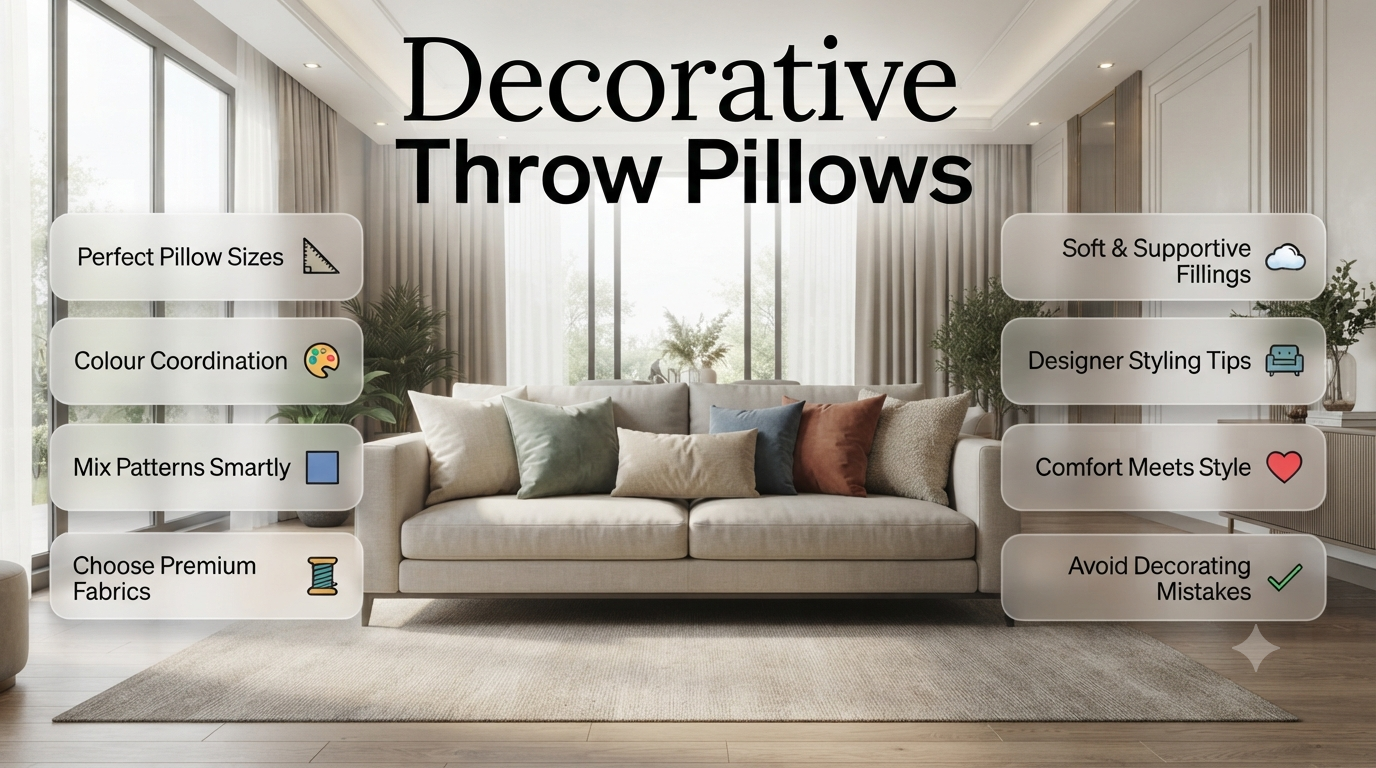
Throw pillows may seem like a small decorating detail, but they can completely transform a room. Whether you’re refreshing your living room, updating a bedroom, or adding personality to an outdoor seating area, the right Decorative Throw Pillows can make a space feel more inviting, comfortable, and stylish without the expense of replacing furniture.
Many homeowners struggle with choosing the right pillow size, colour, pattern, or arrangement. Too many pillows can create clutter, while too few may leave a room looking unfinished. The key is finding the right balance between comfort, function, and design.
In this guide, you’ll learn how to choose decorative throw pillows for every room, understand different fabrics and fillings, discover styling techniques used by interior designers, and avoid common decorating mistakes. Whether your home features a modern, traditional, farmhouse, Scandinavian, or luxury aesthetic, this guide will help you decorate with confidence.
For more decorating inspiration, you can also explore Home Decor and Interior Design ideas that complement your pillow styling choices.
What Are Decorative Throw Pillows?
Decorative throw pillows are soft accent cushions designed to enhance the appearance and comfort of furniture such as sofas, beds, chairs, and benches. Unlike standard sleeping pillows, they primarily serve as decorative accessories while also providing extra support and comfort.
Decorative throw pillows are one of the easiest ways to update a room without investing in new furniture. Available in countless colours, fabrics, shapes, and patterns, they allow homeowners to introduce texture, seasonal accents, or bold statement pieces into their décor.
Because they are relatively affordable, they also make it easy to experiment with changing trends without committing to a complete room makeover.
Why Decorative Throw Pillows Matter
Interior designers often refer to throw pillows as the “finishing touch” because they bring together different design elements within a room. A carefully selected pillow arrangement can:
- Add warmth to minimalist spaces
- Introduce colour without repainting walls
- Create visual balance
- Increase seating comfort
- Highlight seasonal décor
- Tie together different furniture pieces
Imagine a neutral beige sofa. By itself, it may appear plain. Add textured linen pillows in earthy tones with one bold patterned cushion, and the same sofa instantly feels more sophisticated and welcoming.
Why Decorative Throw Pillows Are Worth Investing In
Decorative throw pillows improve both the appearance and comfort of a room. They are an affordable way to refresh interiors, introduce new colours and textures, and create a professionally styled space without replacing furniture.
Many homeowners underestimate how much influence pillows have on a room’s overall atmosphere. They’re not simply accessories—they help define the mood of a space.
They Refresh a Room Instantly
Replacing a sofa or bed can be expensive. Changing your pillows, however, offers an immediate design update at a fraction of the cost.
For example:
- Spring may call for soft floral prints and pastel shades.
- Summer often looks best with light cotton fabrics.
- Autumn introduces warm earth tones.
- Winter pairs beautifully with velvet and faux fur textures.
Instead of redecorating an entire room every season, simply rotating decorative pillows can achieve a fresh new look.
They Improve Comfort
Although decorative pillows are primarily chosen for their appearance, they also serve practical purposes.
They provide support when:
- Reading
- Watching television
- Working from a laptop
- Relaxing on the sofa
- Sitting upright in bed
High-quality inserts can significantly improve everyday comfort while maintaining their attractive shape.
They Add Texture
One of the biggest differences between professionally designed rooms and ordinary interiors is texture.
Rather than using identical pillows, designers combine different materials such as:
- Linen
- Velvet
- Cotton
- Bouclé
- Faux fur
- Knit fabrics
- Embroidered textiles
Mixing textures creates depth, making even neutral spaces feel luxurious.
💡 Pro Tip: Even if your room uses a monochromatic colour palette, combining several textures prevents it from looking flat or boring.
They Introduce Colour Without Commitment
Painting walls or replacing furniture requires significant investment.
Decorative throw pillows let you experiment with:
- Bold accent colours
- Trending colour palettes
- Seasonal themes
- Holiday decorations
If you decide to change your style later, replacing pillows is quick, simple, and budget-friendly.
Types of Decorative Throw Pillows
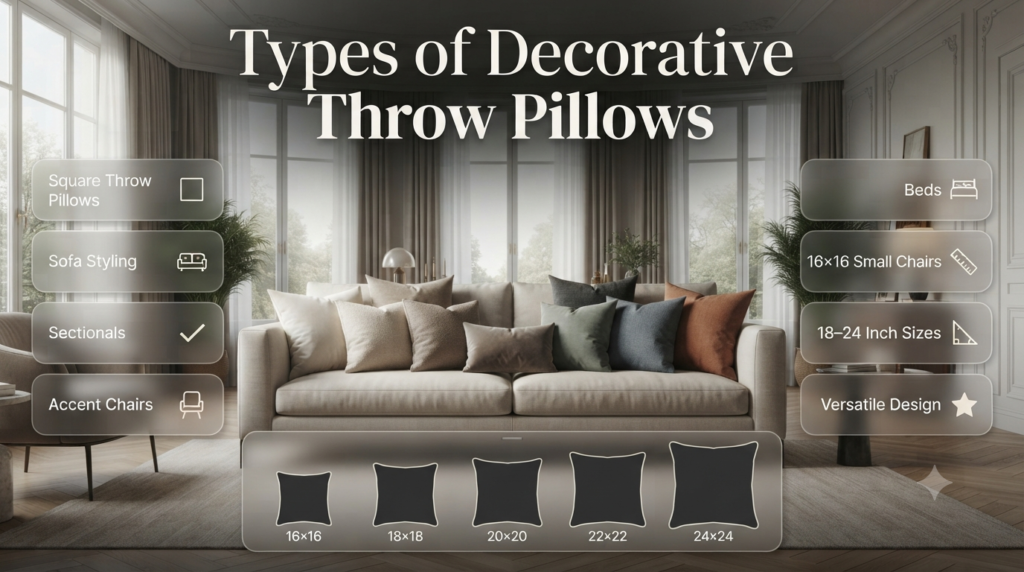
Decorative throw pillows come in many shapes, sizes, and styles. Square pillows remain the most popular, but lumbar, round, bolster, oversized, and novelty pillows each serve different decorative and functional purposes.
Understanding the different types helps you create balanced arrangements instead of randomly placing cushions on furniture.
Square Throw Pillows
Square pillows are the most common option for:
- Sofas
- Sectionals
- Accent chairs
- Beds
Typical sizes include:
| Size | Best For |
|---|---|
| 16 × 16 inches | Small chairs |
| 18 × 18 inches | Standard sofas |
| 20 × 20 inches | Deep sofas |
| 22 × 22 inches | Luxury seating |
| 24 × 24 inches | Large sectionals |
Square pillows are highly versatile and work with almost every decorating style.
Lumbar Pillows
Lumbar pillows are rectangular rather than square.
They provide:
- Lower back support
- A modern layered appearance
- Better posture while sitting
They’re especially popular on:
- Beds
- Window seats
- Entry benches
- Reading chairs
Round Throw Pillows
Round pillows soften rooms filled with straight furniture lines.
They are frequently used in:
- Glam interiors
- Traditional décor
- Vintage-inspired homes
- Luxury bedrooms
Because of their unique shape, they naturally become focal points.
Bolster Pillows
Bolster pillows are long cylindrical cushions often placed:
- Across beds
- On daybeds
- Along window seating
- On decorative benches
They create an elegant hotel-inspired appearance while adding support.
Oversized Throw Pillows
Oversized cushions create a relaxed and luxurious atmosphere.
They work especially well on:
- Large sectional sofas
- Deep seating
- Floor seating arrangements
- Media rooms
However, using too many oversized pillows may reduce available seating space.
⚠ Common Mistake: Choosing oversized pillows for a compact sofa often makes the furniture look crowded and uncomfortable.
Choosing Decorative Throw Pillows for Your Home
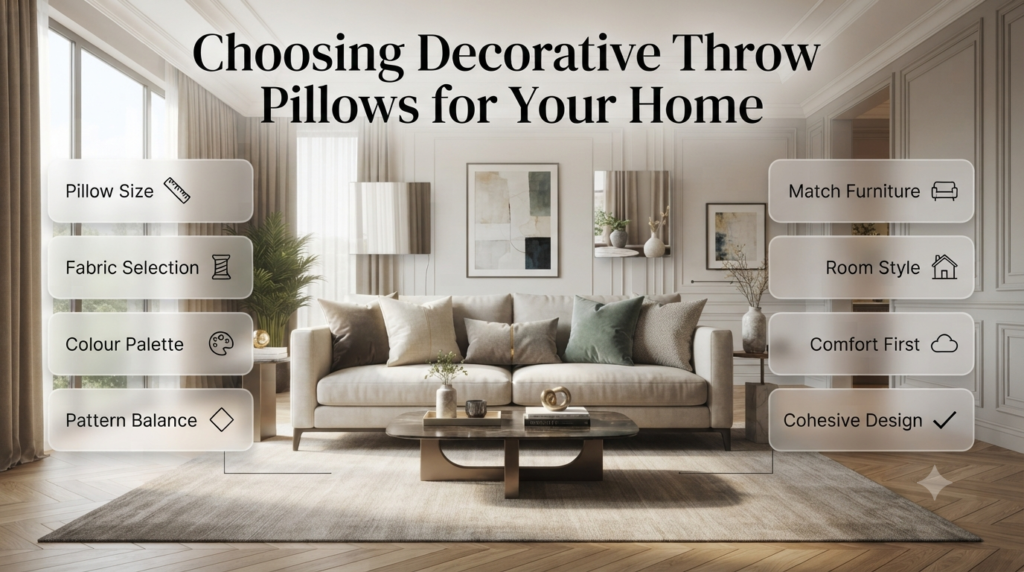
The best decorative throw pillows complement your furniture, colour palette, room size, and decorating style. Consider pillow size, fabric, colour, pattern, and comfort to create a balanced, cohesive look.
Many people buy pillows simply because they like the design. Professional decorators begin with the room as a whole.
Step 1: Consider Your Existing Furniture
Start by evaluating your furniture.
Ask yourself:
- Is the sofa modern or traditional?
- Are the colours warm or cool?
- Is the fabric smooth or textured?
- Does the furniture already have bold patterns?
Your pillows should complement these features rather than compete with them.
For more ideas on coordinating furniture and décor, visit Furniture.
Step 2: Select a Colour Palette
A simple decorating rule many professionals follow is the 60–30–10 principle:
- 60% dominant room colour
- 30% secondary colour
- 10% accent colour
Throw pillows often represent the final 10%, introducing visual interest without overwhelming the room.
For example:
| Sofa Colour | Recommended Pillow Colours |
|---|---|
| White | Navy, olive, rust, charcoal |
| Grey | Mustard, emerald, blush, cream |
| Beige | Terracotta, sage, chocolate |
| Navy | Ivory, gold, light grey |
| Green | Beige, cream, burnt orange |
Step 3: Mix Patterns Carefully
Pattern mixing adds personality when done correctly.
A balanced combination often includes:
- One large-scale pattern
- One medium geometric design
- One subtle texture
- One solid colour
This approach keeps arrangements visually interesting without appearing chaotic.
Step 4: Choose Quality Fabrics
Fabric affects both durability and appearance.
Popular choices include:
| Fabric | Best For |
|---|---|
| Cotton | Everyday use |
| Linen | Casual interiors |
| Velvet | Luxury rooms |
| Faux Fur | Winter décor |
| Bouclé | Modern homes |
| Leather | Industrial interiors |
| Silk | Formal spaces |
Different fabrics also reflect light differently, influencing the room’s overall ambience.
⭐ Expert Tip: Instead of buying every pillow in the same fabric, combine two or three complementary materials. Layering textures creates the rich, designer-inspired look often seen in professionally styled homes.
Step 5: Balance Comfort with Style
Beautiful pillows shouldn’t sacrifice comfort.
When shopping, consider:
- Soft yet supportive inserts
- Durable stitching
- Removable covers
- Hidden zippers
- Machine-washable fabrics for everyday use
If the pillows flatten quickly or lose their shape, they won’t maintain the polished appearance you’re aiming for.
How Many Throw Pillows Do You Need?
The ideal number of decorative throw pillows depends on the size of your furniture. Most standard sofas look balanced with three to five pillows, while larger sectionals can comfortably accommodate five to nine.
As a general guideline:
| Furniture | Recommended Number |
|---|---|
| Accent Chair | 1 |
| Loveseat | 2–3 |
| Three-Seater Sofa | 3–5 |
| Large Sectional | 5–9 |
| Queen Bed | 3–5 |
| King Bed | 5–7 |
Remember that decorative pillows should enhance comfort, not make seating impractical.
📌 Quick Tip: Before buying new pillows, remove your existing ones and experiment with different arrangements. Sometimes simply changing the layout creates a completely refreshed look without purchasing additional décor.
How to Style Decorative Throw Pillows Like an Interior Designer
Professional designers style decorative throw pillows by layering different sizes, combining complementary colours, mixing textures, and using odd-numbered arrangements. The goal is to create balance rather than perfect symmetry, making the space feel inviting and naturally elegant.
Throw pillows are much more than accessories. When arranged thoughtfully, they guide the eye, soften furniture, and make a room look professionally designed.
Start with Larger Pillows
Always begin with your largest pillows at the back.
This creates a strong visual foundation before adding medium and smaller accent cushions.
A typical sofa arrangement might include:
- Two 22″ × 22″ pillows
- Two 20″ × 20″ pillows
- One lumbar pillow in the centre
This layered approach adds depth while keeping the arrangement organised.
Mix Solid Colours and Patterns
Too many solid pillows can look flat, while too many patterns may feel overwhelming.
A balanced combination often includes:
- 50% solid colours
- 30% textured fabrics
- 20% patterned pillows
This ratio creates interest without making the room feel busy.
Layer Different Textures
Texture often has a bigger impact than colour.
Try combining materials like:
- Linen
- Velvet
- Cotton
- Bouclé
- Faux fur
- Chunky knit
- Embroidered fabrics
Even neutral rooms become visually rich when different textures work together.
💡 Pro Tip: If your sofa is made from smooth leather, pair it with soft fabrics such as velvet and woven linen to create contrast.
Don’t Aim for Perfect Symmetry
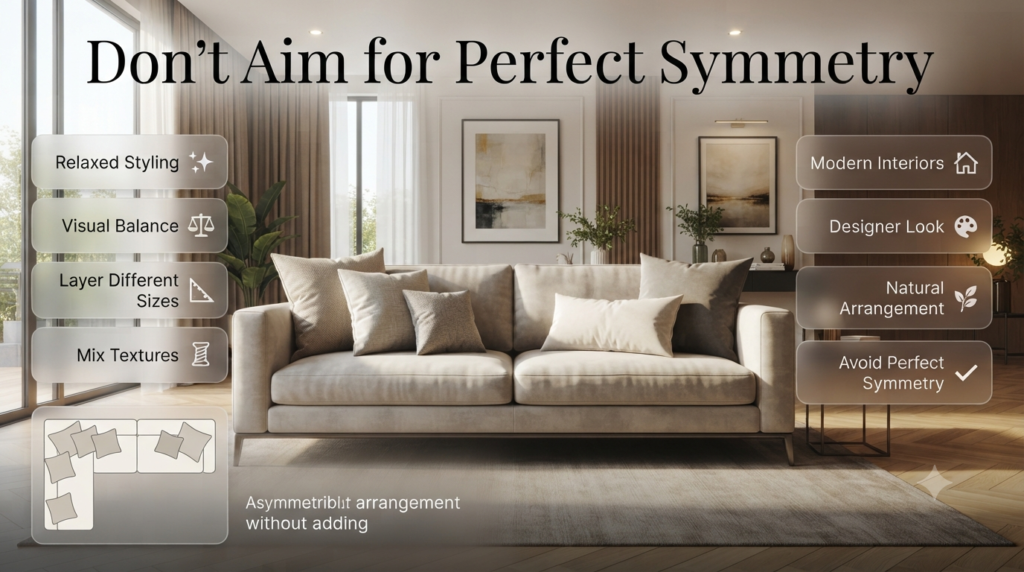
Formal interiors often use symmetrical arrangements.
Modern homes usually feel more relaxed with slightly asymmetrical styling.
For example:
□   □      □
   ▭
□        □
This arrangement feels casual while remaining balanced.
Decorative Throw Pillows for Different Interior Styles
The best throw pillows match the overall design style of your home. Modern interiors favour simple patterns, while farmhouse, bohemian, coastal, and traditional spaces each benefit from distinctive colours, textures, and materials.
Choosing pillows that reflect your decorating style helps create a cohesive room instead of one that feels mismatched.
Modern Style
Modern interiors focus on simplicity.
Choose pillows with:
- Neutral colours
- Minimal patterns
- Clean geometric designs
- Soft textures
- Matte fabrics
Popular colours include:
- White
- Grey
- Black
- Beige
- Charcoal
- Olive green
Scandinavian Style
Scandinavian décor emphasises comfort and simplicity.
Ideal choices include:
- Linen covers
- Cream tones
- Light grey
- Soft beige
- Muted blue
- Wool textures
Natural materials work especially well.
Farmhouse Style
Farmhouse decorating combines warmth with rustic charm.
Popular pillow features include:
- Cotton fabrics
- Plaid patterns
- Stripes
- Neutral colours
- Woven textures
Earthy colours such as cream, tan, sage, and rust complete the look.
Bohemian Style
Boho interiors encourage creativity.
Mix:
- Bright colours
- Tassels
- Fringe
- Embroidery
- Tribal prints
- Global-inspired patterns
Layering multiple textures is encouraged.
Luxury Style
Luxury spaces focus on premium materials.
Common choices include:
- Velvet
- Silk
- Satin
- Metallic embroidery
- Faux fur
- High-density feather inserts
Deep jewel tones create an elegant appearance.
⭐ Expert Tip: Luxury rooms rarely rely on bright colours alone. Instead, they combine rich fabrics with subtle colour palettes to create timeless elegance.
Choosing the Right Fabric
The best throw pillow fabric depends on where the pillow will be used. Cotton and linen are ideal for everyday living spaces, while velvet, silk, faux fur, and leather are better suited for decorative or formal settings.
Different fabrics influence durability, maintenance, and comfort.
| Fabric | Softness | Durability | Best Location |
|---|---|---|---|
| Cotton | High | Excellent | Living room |
| Linen | Medium | Excellent | Modern interiors |
| Velvet | Very High | Good | Luxury spaces |
| Bouclé | High | Good | Contemporary décor |
| Faux Fur | Very High | Medium | Winter styling |
| Leather | Medium | Excellent | Offices & industrial rooms |
| Silk | Very High | Moderate | Formal rooms |
Cotton
Cotton remains one of the most practical choices.
Advantages include:
- Breathable
- Affordable
- Easy to wash
- Comfortable
- Available in thousands of designs
Perfect for families with children.
Linen
Linen offers a relaxed appearance.
Benefits include:
- Natural fibres
- Excellent airflow
- Elegant texture
- Timeless style
Small wrinkles are normal and often enhance its character.
Velvet
Velvet instantly elevates a room.
Its advantages include:
- Rich appearance
- Soft texture
- Excellent depth of colour
- Luxury feel
It pairs beautifully with metallic accents and wooden furniture.
Bouclé
Bouclé has become increasingly popular in contemporary interiors.
Its looped texture adds warmth without requiring bold colours.
Ideal for:
- Minimalist homes
- Scandinavian interiors
- Organic modern designs
Choosing the Right Pillow Insert
The cover affects appearance, but the insert determines comfort.
Common filling materials include:
Polyester Fill
Advantages:
- Budget-friendly
- Lightweight
- Hypoallergenic
- Easy maintenance
Disadvantages:
- Can flatten over time
- Less luxurious
Feather and Down
Premium interiors often use feather inserts.
Benefits:
- Soft support
- Fluffy appearance
- Designer look
Drawbacks:
- Requires regular fluffing
- Usually more expensive
Memory Foam
Memory foam provides excellent support.
Best suited for:
- Reading chairs
- Office seating
- Lumbar pillows
They maintain their shape longer than standard polyester fills.
⚠ Common Mistake: Buying beautiful covers but using low-quality inserts. Even premium fabrics look flat when filled with poor-quality cushions.
Choosing Decorative Throw Pillows by Room
Different rooms require different pillow styles. Living rooms prioritise comfort and aesthetics, bedrooms focus on layering, while outdoor spaces need weather-resistant fabrics.
Living Room
The living room offers the most flexibility.
Good combinations include:
- Neutral base pillows
- One bold accent colour
- One textured pillow
- One patterned pillow
This creates visual balance without overwhelming the seating.
Bedroom
Beds benefit from layered arrangements.
A common king-size layout includes:
- Two sleeping pillows
- Two Euro pillows
- Two decorative square pillows
- One lumbar pillow
The result resembles a boutique hotel.
Reading Nook
Comfort takes priority.
Choose:
- Soft fabrics
- Lumbar support
- Warm colours
- Medium-sized cushions
The goal is to encourage long, comfortable reading sessions.
Home Office
Decorative pillows can soften office furniture.
Choose:
- Neutral tones
- Lumbar support
- Durable fabrics
Avoid oversized decorative cushions that reduce chair comfort.
Outdoor Spaces
Outdoor throw pillows should be made from weather-resistant materials.
Look for:
- UV-resistant fabrics
- Water-resistant covers
- Mould-resistant filling
- Fade-resistant colours
Store outdoor pillows indoors during heavy rain or extended periods of harsh weather to extend their lifespan.
Decorating with Seasonal Throw Pillows
Seasonal throw pillows refresh your home throughout the year by introducing colours, textures, and patterns that reflect each season without requiring a complete redesign.
Changing pillow covers is one of the simplest ways to keep your home feeling fresh.
| Season | Recommended Colours | Fabrics |
|---|---|---|
| Spring | Sage, blush, lavender | Cotton, linen |
| Summer | White, aqua, coral | Linen, canvas |
| Autumn | Rust, mustard, olive | Velvet, woven cotton |
| Winter | Emerald, navy, burgundy | Velvet, faux fur |
Changing only a few pillow covers can completely transform the atmosphere of a room.
📌 Quick Tip: Store off-season pillow covers in breathable fabric bags rather than plastic containers to help preserve colours and prevent trapped moisture.
Mixing Colours Like a Professional
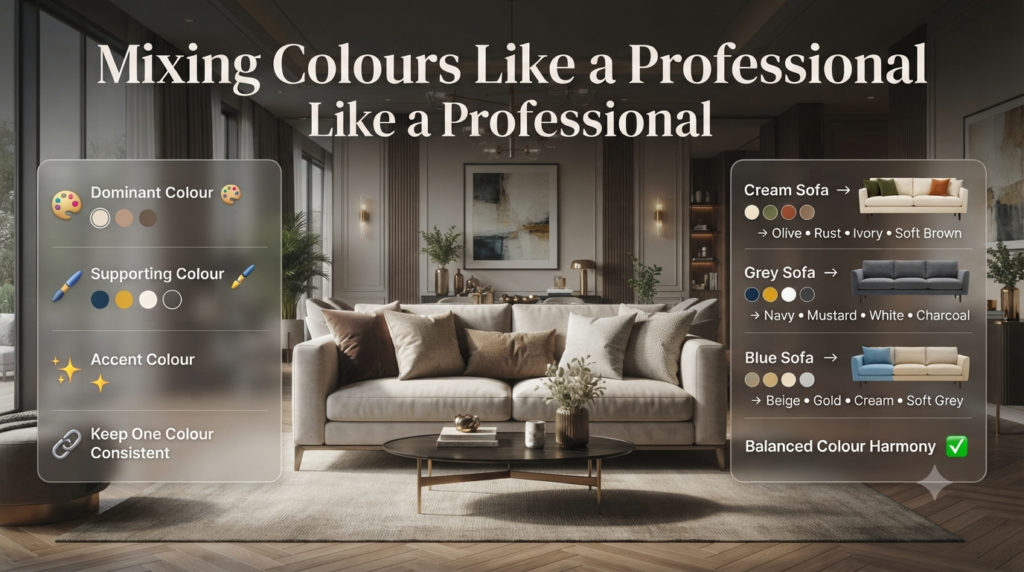
Many homeowners worry about choosing colours that clash.
A simple formula makes the process much easier.
Choose:
- One dominant colour
- One supporting colour
- One accent colour
Example:
Cream Sofa
- Olive green
- Rust orange
- Ivory
- Soft brown
Example:
Grey Sofa
- Navy
- Mustard
- White
- Charcoal
Example:
Blue Sofa
- Beige
- Gold
- Cream
- Soft grey
Keeping one colour consistent throughout the arrangement helps everything feel connected.
Decorative Throw Pillows: Pros and Cons
| Pros | Cons |
|---|---|
| Instantly refresh a room | Can become cluttered if overused |
| Affordable decorating solution | Require occasional cleaning |
| Add comfort and support | Quality versions cost more |
| Introduce colour and texture | Feather inserts need regular fluffing |
| Easy to replace seasonally | Cheap fabrics may fade over time |
| Suitable for every decorating style | Too many pillows reduce seating space |
Designer’s Quick Checklist Before Buying
Use this checklist before purchasing decorative throw pillows:
✔ Measure your sofa, bed, or chair.
✔ Choose a consistent colour palette.
✔ Mix solids, textures, and patterns.
✔ Select durable fabrics for everyday use.
✔ Invest in quality inserts.
✔ Consider seasonal updates with removable covers.
✔ Avoid overcrowding furniture.
✔ Coordinate pillows with rugs, curtains, and artwork rather than trying to match everything exactly.
For more inspiration on coordinating soft furnishings with your home, explore Room Design, Home Improvement Tips, and the Home Page for additional decorating guides.
Common Mistakes People Make with Decorative Throw Pillows
The most common decorative throw pillow mistakes include choosing the wrong size, using too many matching pillows, ignoring texture, overcrowding furniture, and selecting fabrics that don’t suit everyday use. Avoiding these mistakes creates a more balanced and comfortable space.
Even expensive pillows won’t improve a room if they’re styled incorrectly. Fortunately, most decorating mistakes are easy to fix.
1. Buying the Wrong Size
Many people purchase pillows without measuring their furniture first.
For example:
- Small pillows disappear on oversized sectionals.
- Oversized cushions can overwhelm compact loveseats.
- Thin lumbar pillows may look out of proportion on large beds.
How to avoid it:
Measure your furniture before shopping and choose pillow sizes that suit the scale of the room.
2. Using Too Many Matching Pillows
Buying an entire matching pillow set may seem convenient, but it often makes a room look flat and less inviting.
Instead, combine:
- Solid colours
- Textured fabrics
- Small-scale patterns
- One bold statement pillow
This creates a layered, professionally styled look.
3. Ignoring Texture
Colour isn’t the only design element that matters.
A room filled with smooth cotton pillows can feel one-dimensional.
Add contrast with materials such as:
- Velvet
- Linen
- Bouclé
- Knit fabrics
- Faux fur
- Embroidered textiles
Texture adds warmth and visual depth, even when using neutral colours.
4. Choosing Style Over Comfort
Beautiful pillows should still be comfortable.
Avoid:
- Extremely stiff inserts
- Rough fabrics in high-use areas
- Delicate materials on family sofas
Decorative accessories should enhance everyday living, not make furniture uncomfortable.
5. Overcrowding the Furniture
A sofa should remain functional.
If guests need to remove six pillows before sitting down, you’ve probably used too many.
Aim for balance rather than maximum decoration.
⚠ Common Mistake: Filling every available space with pillows can make even a large room feel cluttered and smaller than it actually is.
6. Forgetting About Maintenance
Some decorative fabrics require professional cleaning.
Before purchasing, check:
- Cleaning instructions
- Removable covers
- Washability
- Fade resistance
- Durability
Easy-care materials save time and help pillows look fresh for longer.
Expert Tips for Decorating with Throw Pillows
Interior designers rarely rely on trends alone. Instead, they follow practical principles that work across different styles and room sizes.
Here are some professional recommendations you can use in your own home.
Layer from Large to Small
Always begin with the largest pillows at the back and gradually move towards smaller accent cushions.
This creates depth and makes arrangements look intentional.
Repeat Accent Colours
If your room includes navy artwork, consider repeating navy in one or two throw pillows.
Repeating colours throughout a room creates visual harmony.
Mix Shapes
Rather than using only square cushions, include:
- Lumbar pillows
- Round cushions
- Bolster pillows
Different shapes add movement and prevent repetitive layouts.
⭐ Expert Tip: Designers often follow the “odd-number rule.” Arrangements with three or five pillows usually feel more relaxed and visually appealing than perfectly even groupings.
Refresh Covers Instead of Buying New Inserts
Quality pillow inserts can last for years.
Instead of replacing entire pillows each season, simply update the covers.
Benefits include:
- Lower decorating costs
- Less storage space
- Easier seasonal updates
- More sustainable decorating
Coordinate with the Entire Room
Your throw pillows shouldn’t match only the sofa.
Instead, take inspiration from:
- Curtains
- Area rugs
- Artwork
- Decorative vases
- Blankets
- Upholstery
- Wall colours
The result is a cohesive, thoughtfully designed space.
💡 Pro Tip: Choose one colour from your rug or artwork and repeat it in your throw pillows. This simple technique instantly makes the room feel professionally styled.
How to Clean and Maintain Decorative Throw Pillows
To keep decorative throw pillows looking their best, vacuum them regularly, clean spills quickly, wash removable covers according to the care label, and fluff inserts frequently to maintain their shape.
Regular maintenance extends the life of both pillow covers and inserts.
Weekly Care
A few minutes each week can prevent dust and dirt from building up.
Recommended routine:
- Shake pillows outdoors
- Fluff feather inserts
- Rotate pillows
- Vacuum fabric using a soft brush attachment
Monthly Maintenance
Inspect pillows for:
- Loose stitching
- Fading
- Flattened inserts
- Stains
- Worn zippers
Addressing minor issues early helps prevent more costly replacements later.
Washing Pillow Covers
Always check the manufacturer’s care instructions.
General guidelines:
| Fabric | Cleaning Method |
|---|---|
| Cotton | Machine washable |
| Linen | Gentle machine wash or hand wash |
| Velvet | Spot clean or dry clean |
| Silk | Dry clean recommended |
| Faux Fur | Gentle hand wash if permitted |
| Leather | Wipe with a damp cloth |
Never wash feather inserts unless specifically recommended by the manufacturer.
Storage Tips
If rotating seasonal décor:
- Wash covers before storing.
- Ensure everything is completely dry.
- Fold neatly to avoid creases.
- Store in breathable fabric bags.
- Keep away from direct sunlight and damp areas.
Proper storage helps preserve colours and fabrics for future use.
What is the correct size formula for layering throw pillows on a sofa or bed?
A messy arrangement of mismatched pillows will instantly cheapen a high-end space. From an search engine optimization (SEO) and styling perspective, users frequently search for how to avoid a cluttered look. The secret lies in a descending size scale. You must start from the outside corners with your largest anchoring pillows and work your way inward with progressively smaller sizes. This creates a natural visual funnel that looks tailored rather than chaotic.
The Sofa Formula: Start with two 55×55 cm pillows in the back corners, layer two 50×50 cm pillows in front, and finish with a central 30×50 cm lumbar pillow.
The Bed Formula: Place oversized 65×65 cm European shams against the headboard, followed by standard sleeping pillows, and then your decorative accent pillows.
The Scale Ratio: Never mix more than three distinct sizes on a standard three-seater sofa, or you will completely sacrifice sitting space.
Which pillow insert fill material is best for achieving the luxury “chop” look?
The fill material entirely dictates the comfort, shape, and luxury look of a decorative pillow. Cheap polyester fiberfill inserts bounce back like plastic sponges and cannot hold a shape. If you want that high-end, relaxed look where the pillow indents perfectly at the top when you give it a “karate chop,” you must invest in natural fills. A premium down-and-feather blend provides the weight, malleability, and luxury slouch that synthetic alternatives simply cannot mimic.
The Blend Ratio: Look for a mix of 10% down for softness and 90% feathers for structural support and loft.
Down Alternatives: If allergies are a concern, premium synthetic microfiber inserts mimic down density without the feathers.
The Oversize Trick: Always buy an insert that is 5 centimeters larger than your pillow cover to ensure plush, filled-out corners.
What are the top trending patterns and textures for decorative throw pillows this season?
The era of buying flat, matching sets of identical square pillows is completely over. High-performing search trends show a massive demand for mixed-texture styling that adds tactile depth to neutral furniture. Modern luxury design focuses on combining raw, organic materials with heavy geometric patterns. Bouclé, heavy linen, chunky slub cotton, and high-pile wool are dominating the market right now, often styled alongside rich velvets to break up visual monotony.
Earthy Textures: Bouclé and knitted wool elements bring an organic, cozy warmth to modern leather or fabric sofas.
Asymmetrical Patterns: Bold, abstract geometric blocks and hand-dyed motifs are replacing predictable floral prints.
Trims and Details: Micro-fringing, exposed heavy metal zippers, and contrast piping are driving premium product searches.
How do I mix different patterns and colors without making the room look messy?
Mixing patterns is where most homeowners lose confidence and end up with a sterile, boring setup. The professional rule for mixing pillow patterns is to vary the scale of the designs, not just the colors. You need a unifying color palette—typically three complementary tones—to tie the collection together. Once your palette is locked in, you combine one large-scale pattern, one small-scale pattern, and one solid textured fabric to create balance.
Pattern Hierarchy: Pair a wide, bold stripe (large scale) with a delicate block print (small scale) and a solid velvet pillow.
The Anchor Color: Ensure all chosen patterns contain at least one shared color from your room’s main rug or drapery.
The Odd Number Rule: Arrange your pillows in groupings of three or five for an asymmetrical look that feels natural and relaxed.
What are the best maintenance practices to prevent decorative pillows from losing their shape?
Decorative pillows endure constant compression, oils from skin, and fabric friction. To protect an investment in high-end textiles, maintenance must be a regular routine. Washing delicate embroidered covers or heavy wool weaves in a standard washing machine will cause shrinkage and fabric pilling. A professional care routine ensures the inserts retain their loft and the covers retain their texture over years of daily use.
Daily Fluffing: Hit the pillows from opposite sides simultaneously to force air back into the feather channels and restore loft.
Spot Cleaning: Turn covers inside out and treat minor stains immediately with a damp cloth and mild, enzyme-free detergent.
Insert Sunning: Place feather inserts outside in direct sunlight for a few hours twice a year to naturally deodorize and fluff them.
Conclusion
Decorative throw pillows are one of the simplest yet most effective ways to transform your home’s interior. They add colour, texture, comfort, and personality without the expense of replacing furniture or undertaking major renovations. Whether you prefer a clean modern aesthetic, cosy farmhouse charm, timeless traditional décor, or bold bohemian style, the right throw pillows can instantly elevate the look and feel of any room.
The key to successful styling is balance. Choose pillow sizes that suit your furniture, mix complementary colours with varied textures, and don’t be afraid to combine patterns thoughtfully. Investing in quality fabrics and durable inserts ensures your pillows remain comfortable, attractive, and long-lasting. By updating pillow covers seasonally and following proper cleaning and maintenance practices, you can keep your home looking fresh all year round.
Remember, decorative throw pillows aren’t just accessories—they’re finishing touches that tie an entire room together. Start with a cohesive colour palette, experiment with layering, and let your personal style shine through. Even small changes can make a significant impact, creating a space that feels warm, inviting, and uniquely yours.
For more home styling inspiration, be sure to explore our guides on Home Decor, Interior Design, Room Design, and Furniture, where you’ll find practical ideas to help you create a beautiful, comfortable, and well-designed home.