
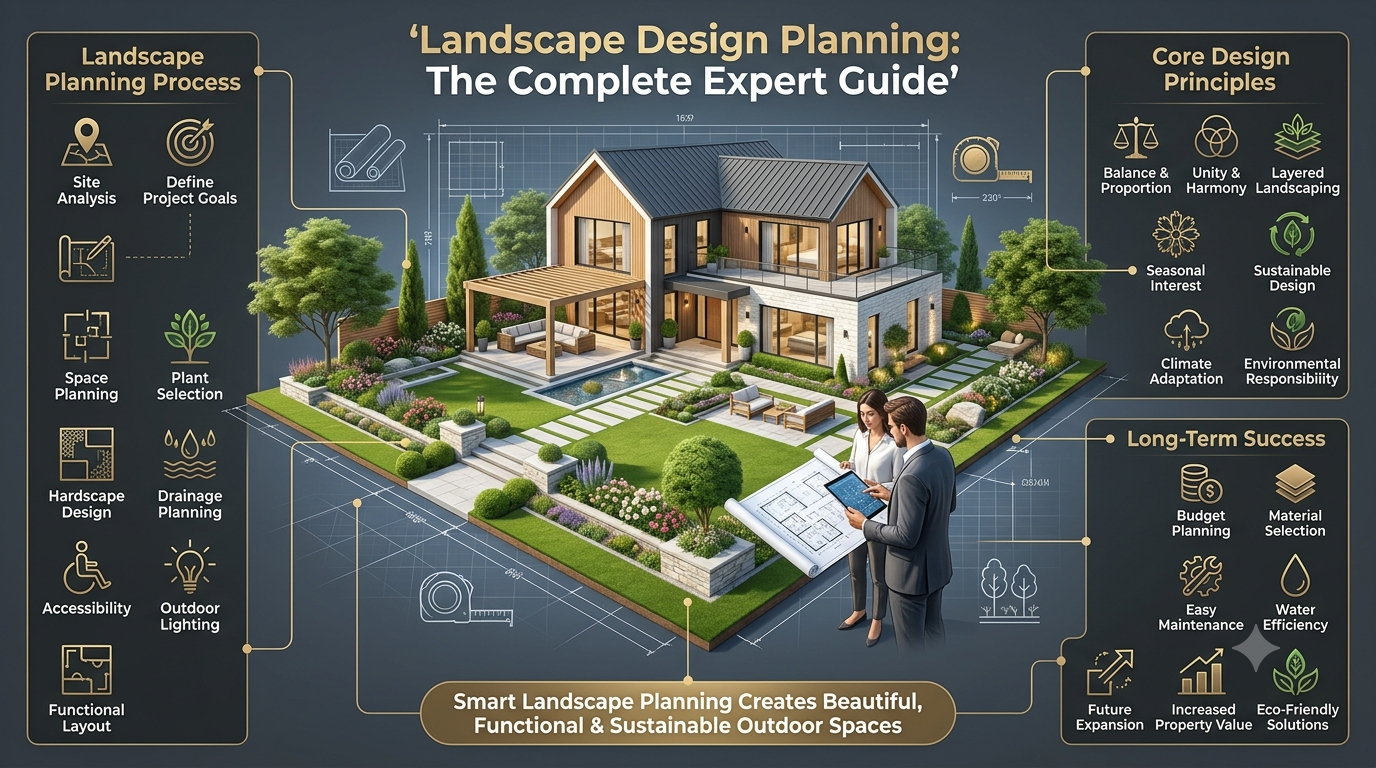
Landscape Design Planning:A well-executed landscape design planning process does much more than improve a property’s appearance. It creates outdoor spaces that are attractive, practical, environmentally responsible, and easier to maintain for years to come. Whether you’re redesigning a small front yard, creating a family-friendly backyard, or planning an outdoor entertainment area, a thoughtful plan helps you avoid expensive mistakes while making the best use of your available space and budget.
Unlike simply choosing plants or installing a patio, landscape planning combines site analysis, design principles, construction considerations, drainage, plant selection, lighting, accessibility, and long-term maintenance into one coordinated strategy. The most successful landscapes balance aesthetics with functionality, ensuring every feature serves a purpose while contributing to a cohesive overall design.
This comprehensive guide explains the complete planning process—from evaluating your property and defining project goals to selecting materials, organizing outdoor spaces, estimating costs, and preparing for future maintenance. Whether you’re a homeowner for homeimprovement & designing tackling a DIY project or working with a professional landscape designer, the information below will help you make informed decisions at every stage.
What Is Landscape Design Planning?
Landscape design planning is the process of organizing outdoor spaces before construction begins to ensure they are functional, visually appealing, sustainable, and practical to maintain.
Rather than making individual landscaping decisions one at a time, planning creates a complete roadmap that guides every aspect of the project. It determines where pathways, patios, gardens, lawns, trees, water features, outdoor lighting, drainage systems, and recreational spaces will be located while ensuring they work together as a unified landscape.
A complete landscape plan generally includes:
- Property measurements
- Existing site conditions
- Functional space allocation
- Planting layouts
- Hardscape locations
- Drainage solutions
- Irrigation planning
- Lighting placement
- Material selections
- Maintenance considerations
- Future expansion opportunities
Professional designers rarely begin installation without first developing a detailed plan because correcting mistakes after construction is significantly more expensive than making adjustments during the planning stage.
Why Proper Landscape Planning Matters
Good planning reduces costs, improves functionality, and helps create an outdoor environment that continues to perform well over time.
Many landscaping projects fail because homeowners focus on individual features instead of understanding how those features interact. A beautiful patio may collect standing water if drainage isn’t considered. Attractive trees may eventually block windows or damage foundations if planted too close to the house. Without planning, these issues often become costly to correct.
Landscape planning provides a structured approach that considers the entire property rather than isolated improvements. Every decision—from plant spacing to walkway placement—is evaluated within the context of the overall design.
Professional planning also helps prioritize investments. Instead of completing projects randomly, homeowners can divide the work into logical phases while maintaining a consistent long-term vision.
Benefits of Creating a Landscape Plan Before Construction
Creating a detailed landscape plan offers advantages that extend far beyond aesthetics.
| Benefit | Why It Matters |
|---|---|
| Better budget control | Reduces unexpected expenses and change orders |
| Improved functionality | Spaces are designed around everyday activities |
| Higher curb appeal | Creates a balanced and welcoming exterior |
| Easier maintenance | Simplifies mowing, pruning, irrigation, and seasonal care |
| Increased property value | Well-designed landscapes often improve market appeal |
| Better drainage | Helps prevent erosion and water-related damage |
| Efficient material usage | Reduces waste during construction |
| Future flexibility | Allows for phased improvements without disrupting previous work |
A carefully planned landscape also minimizes conflicts between plants, structures, utilities, and future renovations.
Understanding the Complete Landscape Design Process
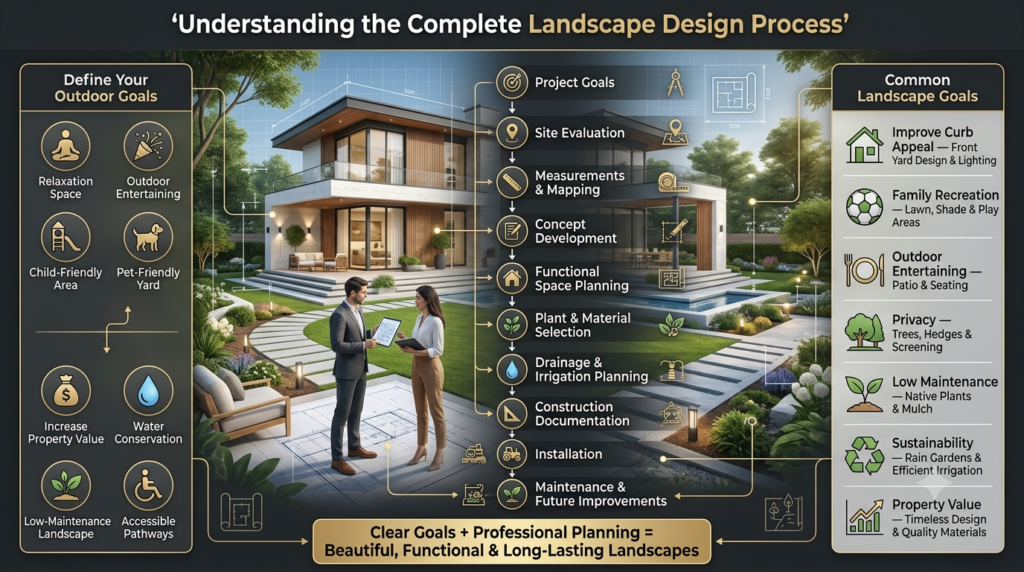
Landscape design planning follows a structured workflow that transforms ideas into a buildable, long-term outdoor environment.
Although every property is unique, professionals generally follow a sequence that ensures each decision is supported by accurate information.
Project Goals
      │
      ▼
Site Evaluation
      │
      ▼
Measurements & Mapping
      │
      ▼
Concept Development
      │
      ▼
Functional Space Planning
      │
      ▼
Plant & Material Selection
      │
      ▼
Drainage & Irrigation Planning
      │
      ▼
Construction Documentation
      │
      ▼
Installation
      │
      ▼
Maintenance & Future Improvements
Following this workflow reduces design conflicts while improving communication between homeowners, contractors, and landscape professionals.
Setting Clear Goals for Your Outdoor Space
Every successful landscape begins with clearly defined objectives rather than design trends.
Before selecting plants or purchasing materials, determine exactly how the space should function. Different priorities lead to very different design decisions.
Ask yourself:
- Will the yard primarily serve as a relaxation space?
- Do you frequently entertain guests outdoors?
- Is a child-friendly play area needed?
- Do pets require dedicated open space?
- Are you aiming to increase property value?
- Is water conservation a priority?
- Do you want a low-maintenance landscape?
- Will aging family members need accessible pathways?
When these questions are answered early, every later decision becomes more focused and practical.
Common Landscape Goals
| Goal | Planning Priority |
|---|---|
| Improve curb appeal | Front yard design, lighting, planting balance |
| Family recreation | Lawn space, durable surfaces, shade |
| Outdoor entertaining | Patio, seating, cooking areas |
| Privacy | Trees, hedges, fencing, screening |
| Low maintenance | Native plants, mulch, simplified layouts |
| Sustainability | Rain gardens, efficient irrigation, drought-tolerant plants |
| Property value | Timeless design and quality materials |
Trying to satisfy every goal equally often results in a cluttered landscape. Prioritizing objectives helps create a more cohesive design.
Evaluating Your Property Before Designing
A thorough property evaluation identifies opportunities and limitations before planning begins.
No two landscapes are identical. Even neighboring homes may differ significantly due to slope, drainage patterns, sunlight, wind exposure, soil composition, or existing vegetation.
Start by documenting:
- Property dimensions
- Building locations
- Existing patios and walkways
- Trees worth preserving
- Utility lines
- Water sources
- Septic systems (where applicable)
- Drainage routes
- Neighboring structures
- Views worth highlighting or screening
This information forms the foundation for every design decision.
Conducting a Professional Site Analysis
Site analysis evaluates environmental conditions that directly affect design success.
Professional landscape designers spend considerable time studying a property’s natural characteristics before developing concepts. Skipping this step often leads to plant failures, drainage problems, and inefficient layouts.
A complete site analysis examines several key factors.
Sunlight Patterns
Observe how sunlight changes throughout the day.
Identify:
- Full sun areas
- Partial shade
- Deep shade
- Seasonal variations
Plant selection depends heavily on these conditions.
Soil Conditions
Healthy landscapes begin with understanding the soil.
Evaluate:
- Drainage speed
- Soil texture
- Organic matter
- Compaction
- Moisture retention
- Soil pH (when appropriate)
Different plants thrive under different soil conditions, making soil assessment one of the most valuable planning activities.
Existing Vegetation
Not every existing tree or shrub should be removed.
Determine:
- Which mature trees provide valuable shade
- Which plants are unhealthy
- Which invasive species require removal
- Which established plants can become focal points
Preserving healthy mature trees often saves years of landscape development.
Topography
Elevation changes influence nearly every aspect of landscape planning.
Study:
- Slopes
- High points
- Low points
- Natural drainage routes
- Erosion risks
Ignoring elevation differences often creates expensive drainage issues after construction.
Wind Exposure
Wind affects both comfort and plant health.
Identify:
- Prevailing wind directions
- Sheltered outdoor spaces
- Areas suitable for windbreak planting
- Locations requiring structural protection
Strategic planting can improve outdoor comfort while protecting delicate vegetation.
Understanding Climate, Soil, and Environmental Conditions
Successful landscapes are designed for local environmental conditions rather than idealized garden photos.
Climate determines which plants survive, how irrigation systems perform, and which construction materials age well over time.
Key environmental factors include:
- Average annual rainfall
- Seasonal temperature ranges
- Frost dates
- Humidity
- Snow loads in colder climates
- Drought frequency
- Coastal salt exposure
- Wind intensity
Selecting plants adapted to local conditions generally reduces maintenance, water usage, and replacement costs.
Professionals also consider regional planting zones, seasonal weather patterns, and long-term climate resilience when developing planting plans.
Measuring and Mapping Your Property
Accurate measurements prevent construction errors and simplify every later stage of the project.
Before creating any landscape drawing, record:
- Property boundaries
- Building dimensions
- Fence locations
- Driveways
- Existing hardscapes
- Utility access points
- Significant trees
- Elevation changes
Even simple hand-drawn sketches become much more valuable when measurements are accurate.
Common measuring tools include:
- Long tape measures
- Measuring wheels
- Laser distance measurers
- Graph paper
- Digital mapping software
- Survey documents (when available)
Professional-grade plans often use scale drawings, allowing contractors to estimate materials and install features with greater precision.
Creating a Realistic Landscape Budget
A realistic budget balances immediate priorities with long-term property improvements while accounting for both visible and hidden costs.
One of the most common mistakes homeowners make is allocating nearly the entire budget to visually impressive features while overlooking essential infrastructure such as drainage, grading, irrigation, and soil preparation. These foundational elements may not be immediately noticeable, but they have a significant impact on the durability and performance of the finished landscape.
When preparing a budget, divide expenses into major categories rather than focusing solely on the final project cost.
| Budget Category | Typical Inclusions |
|---|---|
| Site preparation | Clearing, grading, excavation |
| Hardscape | Patios, walkways, retaining walls |
| Softscape | Trees, shrubs, lawns, flowers |
| Irrigation | Sprinklers, drip systems, controllers |
| Lighting | Path lights, accent lighting, wiring |
| Drainage | French drains, grading improvements, catch basins |
| Outdoor features | Fire pits, pergolas, water features |
| Ongoing maintenance | Mulch, pruning, seasonal care |
A phased approach can make larger projects more manageable. By completing structural work first and adding decorative features over time, homeowners can spread costs without compromising the overall design vision.
Landscape Design Principles Every Homeowner Should Know
Beautiful landscapes are rarely the result of chance. They rely on timeless design principles that create visual harmony while improving usability. Understanding these concepts early in the planning process makes it easier to evaluate ideas, choose materials, and organize outdoor spaces effectively.
Landscape Design Principles Every Homeowner Should Know
Strong landscape design follows a set of proven principles that create outdoor spaces that are both attractive and practical. Rather than decorating a yard with unrelated features, these principles help establish order, improve movement, and ensure the landscape feels intentional.
Professional designers rarely rely on trends alone. Instead, they combine timeless design concepts with the property’s natural characteristics and the homeowner’s lifestyle.
Balance
Balance creates visual stability by distributing elements evenly throughout the landscape. It doesn’t necessarily mean both sides must be identical.
There are two common approaches:
- Symmetrical balance: Formal layouts where both sides mirror each other, often used in traditional homes.
- Asymmetrical balance: Different elements provide equal visual weight, creating a more natural and relaxed appearance.
For example, a large shade tree on one side of a yard may be balanced by a combination of smaller trees, shrubs, and a seating area on the opposite side.
Unity
Unity ensures that every feature feels connected rather than randomly placed.
Materials, colors, plant selections, paving styles, and architectural details should complement one another. Repeating similar textures, plant varieties, or hardscape materials throughout the property helps create consistency without making the landscape repetitive.
Scale and Proportion
Every landscape element should relate appropriately to its surroundings.
Oversized trees can overwhelm a small yard, while tiny planting beds may appear insignificant beside a large home. Patios, pergolas, water features, and garden beds should all be sized according to the available space and intended use.
Maintaining proper proportion creates a landscape that feels comfortable and visually balanced.
Rhythm and Repetition
Repeating certain plants, colors, materials, or shapes guides the eye naturally through the landscape.
For example, repeating ornamental grasses along a pathway or using the same paving material across different outdoor areas creates continuity without sacrificing variety.
Excessive repetition, however, can make a landscape feel monotonous. Strategic variation keeps the design interesting.
Focal Points
Every successful landscape benefits from one or more focal points that immediately attract attention.
Common focal elements include:
- Decorative trees
- Water features
- Outdoor fireplaces
- Sculptures
- Statement planters
- Garden arches
- Feature lighting
- Architectural planting arrangements
Focal points should enhance the design rather than compete with one another.
Simplicity
One of the most overlooked professional design principles is knowing when to stop.
Adding too many plant varieties, decorative objects, or hardscape features often creates visual clutter. A restrained design with carefully selected materials usually appears more elegant and remains easier to maintain over time.
Planning Functional Outdoor Zones
Landscape planning is most effective when the property is divided into functional zones based on how each area will be used.
Instead of viewing the yard as one large open space, professionals organize it into outdoor “rooms,” each serving a specific purpose while remaining visually connected.
Entry Zone
The entry area creates the first impression of the property.
This zone typically includes:
- Front walkway
- Foundation planting
- Porch landscaping
- Accent lighting
- Decorative containers
- Address markers
A welcoming entrance improves curb appeal while guiding visitors naturally toward the home.
Entertainment Zone
Outdoor entertaining areas should comfortably accommodate guests while remaining accessible from the house.
Popular features include:
- Patios
- Outdoor kitchens
- Dining spaces
- Fire pits
- Pergolas
- Seating walls
- Shade structures
Adequate circulation space between furniture is essential to maintain comfort during gatherings.
Recreation Zone
Families often benefit from dedicated activity spaces.
Examples include:
- Open lawn areas
- Children’s play zones
- Swimming pools
- Sports courts
- Pet-friendly areas
Keeping these spaces separate from delicate planting beds reduces maintenance and protects landscaping investments.
Quiet Retreat Zone
Many homeowners want a peaceful area for reading, meditation, or relaxation.
This area may include:
- Garden benches
- Water features
- Shade trees
- Privacy planting
- Fragrant flowers
- Decorative paving
Natural screening helps minimize outside noise while increasing privacy.
Utility Zone
Not every landscape feature is decorative.
Functional areas often include:
- Storage sheds
- Compost bins
- HVAC equipment
- Garbage storage
- Rainwater collection systems
- Vegetable gardens
- Potting stations
These areas should remain accessible while being visually screened from primary living spaces.
Choosing the Right Landscape Design Style
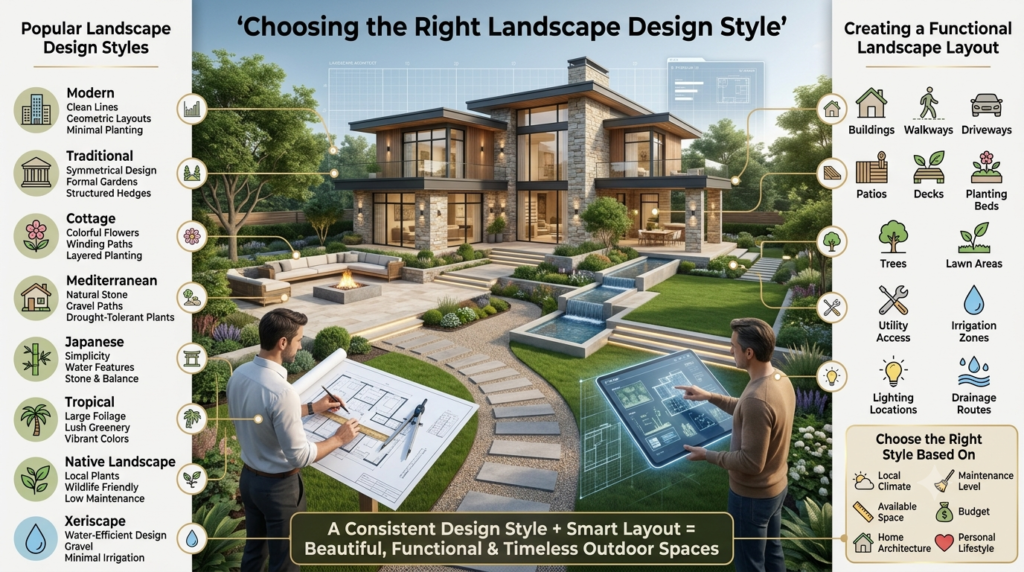
Selecting a design style early creates consistency throughout the project and simplifies material and plant selection.
Rather than mixing unrelated themes, choose a style that complements the home’s architecture, local climate, and personal preferences.
Popular Landscape Styles Comparison
| Style | Best For | Characteristics |
|---|---|---|
| Modern | Contemporary homes | Clean lines, minimal planting, geometric layouts |
| Traditional | Classic architecture | Symmetry, formal gardens, structured hedges |
| Cottage | Informal homes | Colorful flowers, winding paths, layered planting |
| Mediterranean | Warm climates | Stone, gravel, drought-tolerant plants, courtyards |
| Japanese | Quiet gardens | Simplicity, water, stone, balance, symbolism |
| Tropical | Warm regions | Large foliage, lush planting, vibrant colors |
| Native Landscape | Eco-friendly projects | Local plants, wildlife habitat, lower maintenance |
| Xeriscape | Dry climates | Water-efficient planting, gravel, minimal irrigation |
The best choice depends on maintenance expectations, climate, available space, and budget rather than current design trends.
Creating a Functional Landscape Layout
A landscape layout organizes every outdoor feature before construction begins, reducing costly changes later.
Professional layouts typically identify:
- Buildings
- Walkways
- Driveways
- Patios
- Decks
- Planting beds
- Trees
- Lawn areas
- Utility access
- Irrigation zones
- Lighting locations
- Drainage routes
Keeping circulation routes clear is one of the most important planning considerations. Visitors should move comfortably between outdoor areas without crossing planting beds or unnecessary obstacles.
Prioritizing Views and Sightlines
Landscape planning should consider what people see from both inside and outside the home.
Important windows often frame outdoor views, making them an extension of the interior living space.
Enhance desirable views by:
- Highlighting specimen trees
- Adding layered planting
- Positioning water features
- Installing focal lighting
- Framing distant scenery
Reduce undesirable views by screening:
- Neighboring properties
- Utility equipment
- Busy roads
- Parking areas
- Service yards
Proper sightline planning improves both aesthetics and privacy.
Planning Outdoor Circulation
Comfortable movement throughout the landscape is essential for usability and safety.
Every pathway should connect destinations logically while accommodating expected traffic.
Common pathway types include:
| Pathway Type | Primary Purpose |
|---|---|
| Front walkway | Visitor access |
| Garden path | Exploration |
| Service path | Maintenance access |
| Side yard path | Utility movement |
| Patio connection | Entertainment circulation |
Avoid unnecessarily narrow walkways that create bottlenecks, especially near entrances or gathering spaces.
Integrating the Landscape With Home Architecture
A landscape should complement the home’s architectural style rather than compete with it.
Consider:
- Roof lines
- Exterior colors
- Building materials
- Window placement
- Entry design
- Existing structural elements
For example, a modern home typically pairs well with clean planting lines, simple paving patterns, and restrained plant palettes, while traditional homes often benefit from layered gardens and symmetrical layouts.
The goal is to create a seamless transition between indoor and outdoor environments.
Space Optimization for Small and Large Properties
Every property presents unique opportunities regardless of size.
Small Landscapes
To maximize limited space:
- Use vertical planting.
- Choose multi-purpose outdoor features.
- Minimize oversized lawns.
- Create visual depth through layered planting.
- Use diagonal pathways to make areas feel larger.
- Select compact tree varieties.
Large Landscapes
Larger properties require organization to prevent them from feeling empty.
Strategies include:
- Dividing the landscape into outdoor rooms.
- Establishing multiple focal points.
- Creating destination spaces.
- Using tree groupings to define boundaries.
- Connecting zones with consistent pathways.
Regardless of property size, every area should have a clear purpose.
Planning for Privacy Without Feeling Enclosed
Privacy is one of the most requested landscape improvements.
Instead of relying solely on fencing, combine multiple techniques:
- Evergreen hedges
- Layered shrubs
- Ornamental trees
- Decorative screens
- Pergolas
- Climbing vines
- Berms
- Strategic fencing
Layered privacy solutions often look more natural while improving wildlife habitat and seasonal interest.
Common Landscape Planning Mistakes to Avoid
Many landscaping projects exceed their budgets or fail to meet expectations because of avoidable planning errors.
Most Common Mistakes
| Mistake | Potential Result |
|---|---|
| Skipping site analysis | Drainage and planting failures |
| Choosing plants too early | Poor long-term performance |
| Ignoring mature plant size | Overcrowding and expensive removal |
| Underestimating maintenance | Increased long-term costs |
| Poor circulation planning | Awkward movement between spaces |
| Too many design styles | Inconsistent appearance |
| Ignoring drainage | Water damage and erosion |
| Building without a master plan | Costly redesigns later |
Learning from these common mistakes can save significant time, money, and frustration.
Professional Landscape Planning Checklist
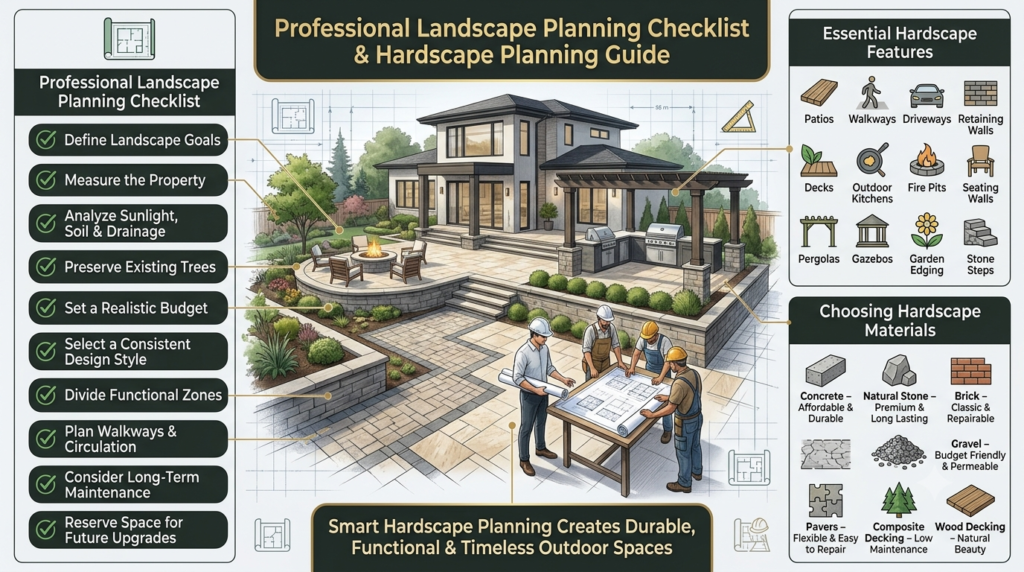
Before moving into detailed planting plans and construction documents, review this checklist:
✔ Define your primary landscape goals.
✔ Measure the entire property accurately.
✔ Analyze sunlight, soil, and drainage.
✔ Identify existing trees worth preserving.
✔ Establish a realistic project budget.
✔ Select a consistent design style.
✔ Divide the property into functional zones.
✔ Plan circulation routes and pathways.
✔ Consider future maintenance requirements.
✔ Reserve space for future improvements.
Completing these steps provides a strong foundation for the next stage of landscape design, where hardscape materials, planting strategies, irrigation systems, drainage solutions, and construction planning are developed in detail.
Hardscape Planning: Building the Structural Foundation of Your Landscape
Hardscape planning determines the permanent features that define how people move through and use an outdoor space. Before selecting plants, professionals usually finalize hardscape elements because patios, walkways, retaining walls, driveways, decks, and outdoor structures establish the framework around which the landscape develops.
Unlike plants, hardscape features are expensive to relocate after installation. Careful planning ensures they support daily activities, complement the home’s architecture, and provide long-term durability.
Common hardscape features include:
- Patios
- Walkways
- Driveways
- Retaining walls
- Decks
- Outdoor kitchens
- Fire pits
- Seating walls
- Pergolas
- Gazebos
- Garden edging
- Stone steps
A well-balanced design blends hardscape with planting areas rather than allowing one to dominate the landscape.
Choosing the Right Hardscape Materials
Material selection affects appearance, maintenance, longevity, and project cost. Every material performs differently depending on climate, foot traffic, and intended use.
| Material | Advantages | Considerations |
|---|---|---|
| Concrete | Affordable, versatile, durable | May crack over time if poorly installed |
| Natural stone | Premium appearance, long lifespan | Higher installation cost |
| Brick | Timeless style, repairable | Requires occasional leveling |
| Gravel | Budget-friendly, permeable | Needs periodic replenishment |
| Pavers | Easy repairs, flexible designs | Requires proper base preparation |
| Composite decking | Low maintenance | Higher initial investment |
| Wood decking | Natural appearance | Requires regular maintenance |
Whenever possible, use materials that complement the home’s exterior finishes to create visual continuity.
Softscape Planning: Bringing the Landscape to Life
Softscape planning focuses on all living elements within the landscape, including trees, shrubs, lawns, flowers, and groundcovers.
Plants provide more than beauty. They improve shade, privacy, biodiversity, erosion control, air quality, and seasonal interest.
A successful planting plan balances aesthetics with long-term growth. Professionals think years ahead, considering how plants will mature rather than how they appear on installation day.
Selecting the Right Plants
Plant selection should begin with site conditions rather than appearance.
Evaluate:
- USDA or local planting zone
- Sun exposure
- Soil drainage
- Soil texture
- Mature plant size
- Water requirements
- Wildlife attraction
- Maintenance expectations
Selecting plants that naturally suit local conditions usually results in healthier gardens with fewer maintenance requirements.
Native Plants vs. Non-Native Plants
Many homeowners wonder whether native plants are always the best option.
The answer depends on project goals.
| Native Plants | Non-Native Plants |
|---|---|
| Adapted to local climate | Greater variety of colors and forms |
| Lower water requirements | Can provide unique visual interest |
| Better wildlife support | May require additional maintenance |
| Often fewer pest issues | Some species become invasive |
A balanced landscape often combines carefully selected native and ornamental species while avoiding invasive plants.
Layering Plants Like a Professional
Professional landscapes rarely consist of random plant placement.
Instead, designers create layers.
Upper Layer
Large shade trees and ornamental trees establish the landscape’s overall structure.
Middle Layer
Shrubs and medium-sized plants provide mass, seasonal interest, and privacy.
Lower Layer
Groundcovers, ornamental grasses, flowering perennials, and mulch complete the design while reducing weeds.
Layered planting creates depth and makes gardens appear fuller without overcrowding.
Lawn Planning
Lawns remain one of the most popular landscape features, but they should be used strategically.
Consider lawn areas for:
- Children’s play
- Pets
- Recreation
- Visual openness
Avoid placing lawn in narrow strips or difficult-to-mow locations. Reducing unnecessary turf often lowers water consumption and maintenance requirements.
Irrigation Planning
An efficient irrigation system helps landscapes remain healthy while minimizing water waste.
Rather than watering every area equally, professionals divide landscapes into irrigation zones based on plant type and water requirements.
Typical irrigation zones include:
- Lawn areas
- Flower beds
- Shrub borders
- Vegetable gardens
- Container planting
This approach improves efficiency while reducing overwatering.
Irrigation Options Comparison
| System | Best For | Advantages |
|---|---|---|
| Drip irrigation | Shrubs and gardens | Highly water efficient |
| Sprinklers | Lawns | Covers large areas |
| Soaker hoses | Garden beds | Affordable and simple |
| Smart irrigation controllers | Entire property | Adjusts watering automatically |
Smart controllers can improve efficiency by adjusting schedules according to weather conditions where compatible systems are available.
Drainage Planning
Drainage is one of the most important yet frequently overlooked aspects of landscape design planning.
Poor drainage can damage foundations, drown plants, erode soil, and shorten the lifespan of hardscape installations.
Professional drainage planning begins before construction.
Key considerations include:
- Natural slopes
- Water flow direction
- Soil permeability
- Roof runoff
- Downspout discharge
- Low spots
- Surface grading
Proper grading often solves many drainage issues before underground systems become necessary.
Common Drainage Solutions
| Problem | Possible Solution |
|---|---|
| Standing water | Regrading or French drain |
| Soil erosion | Groundcovers, retaining walls |
| Excess roof runoff | Rain gardens or drainage piping |
| Wet planting beds | Raised beds or improved soil |
Every drainage solution should direct water safely away from buildings while minimizing erosion.
Outdoor Lighting Planning
Outdoor lighting improves safety, usability, and nighttime curb appeal.
A successful lighting plan combines several lighting types rather than relying on one bright fixture.
Common lighting categories include:
- Path lighting
- Accent lighting
- Step lighting
- Security lighting
- Deck lighting
- Tree uplighting
- Patio lighting
The objective is comfortable visibility rather than excessive brightness.
Sustainable Landscape Planning
Sustainable landscapes reduce resource consumption while supporting healthier outdoor environments.
Professional sustainability strategies include:
- Native plant selection
- Rainwater harvesting
- Compost use
- Mulching
- Drought-tolerant planting
- Permeable paving
- Efficient irrigation
- Pollinator-friendly gardens
These practices often reduce maintenance costs while improving long-term landscape resilience.
Accessibility in Landscape Design
Outdoor spaces should remain comfortable and usable for people of all ages and abilities.
Accessibility improvements may include:
- Wide walkways
- Smooth, slip-resistant surfaces
- Gentle slopes
- Handrails where necessary
- Adequate lighting
- Raised garden beds
- Comfortable seating areas
Planning these features early is usually more cost-effective than retrofitting them later.
Choosing the Right Mulch
Mulch provides both functional and visual benefits.
Benefits include:
- Moisture retention
- Weed suppression
- Soil temperature regulation
- Reduced erosion
- Improved appearance
- Organic matter enrichment (for natural mulches)
Popular options include shredded bark, wood chips, pine straw, compost, and decorative stone, each suited to different landscape styles and maintenance preferences.
Professional Material Selection Tips
Before purchasing landscape materials, consider:
- Local climate
- Freeze-thaw cycles
- UV exposure
- Slip resistance
- Maintenance requirements
- Availability of replacement materials
- Long-term durability
- Overall project budget
Choosing durable materials at the beginning often reduces repair and replacement costs over the life of the landscape.
Preparing for Construction
Before installation begins, complete a final review of the design.
Construction Readiness Checklist
- Final site measurements confirmed
- Drainage plan completed
- Utility locations identified
- Material quantities estimated
- Irrigation layout finalized
- Plant selections approved
- Lighting plan completed
- Construction sequence organized
- Budget reviewed
- Future expansion areas reserved
Completing this checklist helps prevent delays, minimizes costly design changes during construction, and provides contractors with a clear roadmap for installation.
Expert Reviews 100+ for your best Experience
- Landscape Design Planning begins with evaluating the property’s size, layout, and natural features before making design decisions.
- Landscape Design Planning helps homeowners create attractive outdoor spaces that balance beauty with everyday functionality.
- Landscape Design Planning starts by identifying the primary purpose of the landscape, such as relaxation, entertainment, or gardening.
- Landscape Design Planning encourages setting realistic goals that align with both budget and long-term maintenance expectations.
- Landscape Design Planning works best when existing trees, slopes, and drainage patterns are carefully evaluated.
- Landscape Design Planning recommends creating a detailed layout before purchasing plants or construction materials.
- Landscape Design Planning supports organizing outdoor areas into functional zones for different activities.
- Landscape Design Planning becomes more effective when pathways connect outdoor spaces naturally and efficiently.
- Landscape Design Planning encourages selecting plants that thrive in the local climate and soil conditions.
- Landscape Design Planning improves long-term success by considering sunlight and shade throughout the property.
- Landscape Design Planning recommends choosing low-maintenance plants for easier long-term care.
- Landscape Design Planning supports sustainable gardening through water-efficient planting strategies.
- Landscape Design Planning encourages improving soil quality before beginning any planting project.
- Landscape Design Planning helps prevent drainage problems by understanding natural water flow.
- Landscape Design Planning recommends balancing hardscaping with soft landscaping for visual harmony.
- Landscape Design Planning improves outdoor functionality by creating comfortable gathering and seating areas.
- Landscape Design Planning encourages selecting durable paving materials for pathways and patios.
- Landscape Design Planning supports using natural stone, wood, and greenery to create timeless outdoor designs.
- Landscape Design Planning becomes more attractive when plants of varying heights create visual depth.
- Landscape Design Planning recommends incorporating focal points that naturally draw attention.
- Landscape Design Planning supports adding landscape lighting to improve safety and nighttime appearance.
- Landscape Design Planning encourages designing outdoor spaces that remain attractive throughout every season.
- Landscape Design Planning recommends selecting native plants that require less water and maintenance.
- Landscape Design Planning improves biodiversity by combining trees, shrubs, flowers, and ground covers.
- Landscape Design Planning supports creating privacy through hedges, decorative screens, or strategic planting.
- Landscape Design Planning encourages maintaining open areas that preserve comfortable movement throughout the landscape.
- Landscape Design Planning recommends installing efficient irrigation systems to simplify watering routines.
- Landscape Design Planning becomes more sustainable by reducing unnecessary water consumption.
- Landscape Design Planning supports protecting existing mature trees whenever possible during renovations.
- Landscape Design Planning encourages using environmentally friendly landscaping materials whenever practical.
- Landscape Design Planning recommends selecting outdoor furniture that complements the surrounding landscape.
- Landscape Design Planning improves outdoor comfort through carefully positioned shade structures.
- Landscape Design Planning supports creating attractive entrance areas that improve curb appeal.
- Landscape Design Planning encourages designing gardens that remain visually balanced as plants mature.
- Landscape Design Planning recommends planning future growth to avoid overcrowded planting beds.
- Landscape Design Planning improves maintenance efficiency through organized planting layouts.
- Landscape Design Planning supports using decorative borders to define different landscape zones.
- Landscape Design Planning encourages combining practical functionality with creative design ideas.
- Landscape Design Planning recommends selecting durable materials that withstand changing weather conditions.
- Landscape Design Planning improves long-term property value through thoughtful outdoor improvements.
- Landscape Design Planning supports creating child-friendly and pet-friendly outdoor environments where needed.
- Landscape Design Planning encourages reviewing maintenance requirements before finalizing the design.
- Landscape Design Planning recommends balancing seasonal flowers with evergreen plants for year-round beauty.
- Landscape Design Planning improves outdoor living by integrating patios, walkways, and garden spaces.
- Landscape Design Planning supports creating relaxing outdoor environments through thoughtful plant selection.
- Landscape Design Planning encourages preserving natural views while enhancing overall landscape aesthetics.
- Landscape Design Planning recommends updating landscape features gradually as household needs evolve.
- Landscape Design Planning improves project success through careful budgeting and phased implementation.
- Landscape Design Planning supports long-term satisfaction by combining beauty, sustainability, and practical maintenance.
- Landscape Design Planning ultimately transforms outdoor spaces into functional, attractive, and sustainable environments by combining careful site analysis, thoughtful plant selection, durable materials, efficient layouts, environmental responsibility, and long-term maintenance strategies that enhance both property value and everyday outdoor living.
Frequently Asked Faqs
1. What is landscape design planning?
Landscape design planning is the process of organizing outdoor spaces before construction begins to ensure they are functional, visually appealing, and environmentally sustainable. It involves evaluating the property’s size, terrain, climate, drainage, sunlight, soil conditions, and the homeowner’s lifestyle before deciding where to place lawns, gardens, patios, pathways, trees, lighting, and other landscape features. Proper planning helps create a cohesive outdoor environment that balances beauty with long-term practicality.
Rather than making random design decisions, landscape planning establishes a clear blueprint that guides every stage of the project. A well-prepared plan minimizes costly mistakes, improves maintenance efficiency, supports healthy plant growth, and ensures that every element works together to enhance the property’s appearance, usability, and long-term value.
Key elements of landscape design planning:
Analyze the site’s existing conditions.
Define functional outdoor living areas.
Plan hardscape and softscape features.
Consider drainage and irrigation needs.
Select plants suited to the local climate.
Develop a realistic project budget and timeline.
Why is landscape planning important before starting a project?
Landscape planning provides a strategic foundation that helps homeowners avoid expensive design errors and construction changes later in the project. By carefully evaluating the property’s layout, environmental conditions, and intended use before installation begins, homeowners can create outdoor spaces that are attractive, functional, and easier to maintain for years to come.
Planning also improves project efficiency by coordinating grading, drainage, utilities, plant placement, and outdoor structures before any work starts. This proactive approach reduces material waste, improves construction quality, and ensures that each landscape feature contributes to the overall design instead of creating future maintenance problems.
Benefits of planning first:
Prevents costly redesigns and mistakes.
Improves drainage and water management.
Maximizes available outdoor space.
Supports healthier plant growth.
Simplifies future maintenance.
Increases long-term property value.
What is the difference between landscape design and landscape planning?
Although the terms are often used together, landscape planning and landscape design serve different purposes. Landscape planning focuses on the overall strategy for the property, including site analysis, zoning, drainage, circulation, environmental conditions, and long-term functionality. It determines how the outdoor space should work before detailed design decisions are made.
Landscape design builds upon that plan by selecting specific materials, plants, colors, textures, lighting, furniture, and decorative elements. In simple terms, planning establishes the framework, while design brings the vision to life through detailed visual and aesthetic choices.
Landscape planning focuses on:
Site evaluation and analysis.
Functional space allocation.
Drainage and grading.
Environmental considerations.
Long-term usability.
Project sequencing.
Landscape design focuses on:
Plant selection.
Material choices.
Color and texture.
Outdoor furniture.
Lighting placement.
Visual aesthetics.
How do I start planning my landscape?
The first step in landscape planning is understanding both the property’s natural conditions and your personal goals. Walk through the site at different times of day to observe sunlight, shade, drainage patterns, wind exposure, and existing vegetation. At the same time, consider how you want to use the space—whether for entertaining, gardening, relaxing, children’s play areas, or outdoor dining.
After gathering this information, create a scaled sketch showing property boundaries, existing structures, utilities, trees, and major landscape features. Dividing the yard into functional zones helps organize the project while making future construction more efficient and budget-friendly.
Steps to begin planning:
Measure and map the property.
Evaluate sunlight, soil, and drainage.
Identify existing trees and structures.
Define outdoor activity zones.
Establish a realistic budget.
Create a phased implementation plan.
Should I hire a landscape designer or do it myself?
The right choice depends on the project’s complexity, your experience, and your available budget. Small landscaping projects such as flower beds, container gardens, simple pathways, or decorative planting can often be planned successfully by homeowners using basic design principles and careful research. DIY projects also provide greater flexibility while reducing labor costs.
For large-scale renovations involving grading, drainage, retaining walls, irrigation systems, outdoor kitchens, lighting plans, or significant structural changes, hiring a professional landscape designer is often a worthwhile investment. Professional expertise helps avoid expensive mistakes while ensuring the final design is attractive, practical, and compliant with local regulations.
DIY is suitable for:
Small garden projects.
Basic planting plans.
Mulching and edging.
Decorative pathways.
Seasonal landscape updates.
Simple outdoor improvements.
Hire a professional for:
Complete landscape redesigns.
Drainage and grading solutions.
Retaining walls.
Irrigation systems.
Outdoor living structures.
Large residential properties.
How much does landscape design planning cost?
Landscape design planning costs vary depending on property size, project complexity, design requirements, and whether you hire a professional designer or prepare the plan yourself. Basic planning for small residential landscapes generally costs much less than comprehensive master plans for large properties that include grading, irrigation, lighting, outdoor structures, and detailed construction drawings.
While professional planning requires an upfront investment, it often reduces overall project costs by preventing design errors, minimizing material waste, improving construction efficiency, and helping contractors work from a clear, organized plan.
Factors affecting design costs:
Property size.
Site complexity.
Design detail required.
Professional experience.
Construction documentation.
Additional services such as 3D visualization or irrigation planning.
7. What should be included in a landscape design plan?
A complete landscape design plan serves as the blueprint for every stage of the project. It combines functional planning, environmental analysis, construction details, and aesthetic design into a single document that guides installation while ensuring every outdoor feature works together effectively.
The plan should clearly show the location of hardscape elements, planting areas, drainage systems, irrigation, lighting, outdoor living spaces, and circulation paths. It should also include material specifications, plant selections, dimensions, and phased implementation where appropriate.
A professional landscape design plan should include:
Site measurements and property boundaries.
Existing trees and landscape features.
Planting plans and plant schedules.
Patios, walkways, and hardscape layouts.
Drainage and irrigation systems.
Outdoor lighting placement.
Material specifications and construction notes.
Budget estimates and project phases.