

Have you ever walked into a beautifully decorated home and wondered why it instantly felt elegant? Surprisingly, the answer isn’t always expensive furniture or luxury flooring. In many cases, it’s the curtains. Choosing the wrong curtains can make an otherwise beautiful room feel unfinished, outdated, or even smaller than it really is. That’s why understanding the Curtain Mistakes That Make Your Home Look Cheap is so important if you want your home to look polished without spending a fortune.
The good news is that most curtain mistakes are easy to fix once you know what to look for. Whether you’re decorating a new home, renovating a room, or simply replacing old window treatments, a few smart changes can dramatically improve the overall appearance of your space.
In this guide, you’ll learn the most common curtain mistakes homeowners make, why they affect your home’s appearance, and the professional decorating tricks that instantly create a more expensive, designer-inspired look.
Why Curtains Have Such a Big Impact on Interior Design
Curtains are one of the largest decorative elements in a room. They influence natural light, ceiling height, room proportions, color balance, and overall style. Well-chosen curtains make a room feel brighter, taller, and more luxurious, while poor choices can make even expensive interiors look cheap and outdated.
Curtains are much more than window coverings. They frame your windows, soften hard architectural lines, control privacy, and tie together every decorative element in a room.
Interior designers often describe curtains as the “frame” around your home’s view. Just like a beautiful painting loses its appeal in a poor-quality frame, an attractive room can lose much of its charm because of badly chosen curtains.
Curtains influence:
- Natural lighting
- Visual room height
- Window proportions
- Color harmony
- Texture and warmth
- Overall style consistency
A well-selected curtain can make standard windows appear grander, while the wrong one may shrink the room visually.
If you’re planning a complete makeover, exploring more Room Design ideas can help you coordinate your curtains with the rest of your interior.
Mistake #1: Hanging Curtains Too Low
Hanging curtain rods directly above the window frame is one of the most common decorating mistakes. Mounting the rod closer to the ceiling creates the illusion of taller ceilings and larger windows, making the room appear more spacious and elegant.
Many homeowners automatically install curtain rods just a few inches above the window because it seems logical. Unfortunately, this simple habit instantly reduces the visual height of the room.
Professional designers almost always mount curtain rods much higher.
Why It Makes Your Home Look Cheap
Low curtain rods:
- Make ceilings appear shorter.
- Reduce natural light.
- Make windows seem smaller.
- Create an outdated appearance.
- Break the room’s visual balance.
Designer Recommendation
Instead of placing the rod immediately above the window:
- Install it 6–12 inches above the frame, or
- Position it just below the ceiling if possible.
This simple adjustment draws the eye upward and creates a luxury hotel-style appearance.
| Wrong Placement | Better Placement |
|---|---|
| Directly above window | Near the ceiling |
| Makes room shorter | Makes room taller |
| Windows appear smaller | Windows appear larger |
| Basic appearance | Designer-inspired finish |
💡 Pro Tip: Even inexpensive curtains can look high-end when they are mounted higher than the window frame.
Mistake #2: Choosing Curtains That Are Too Short
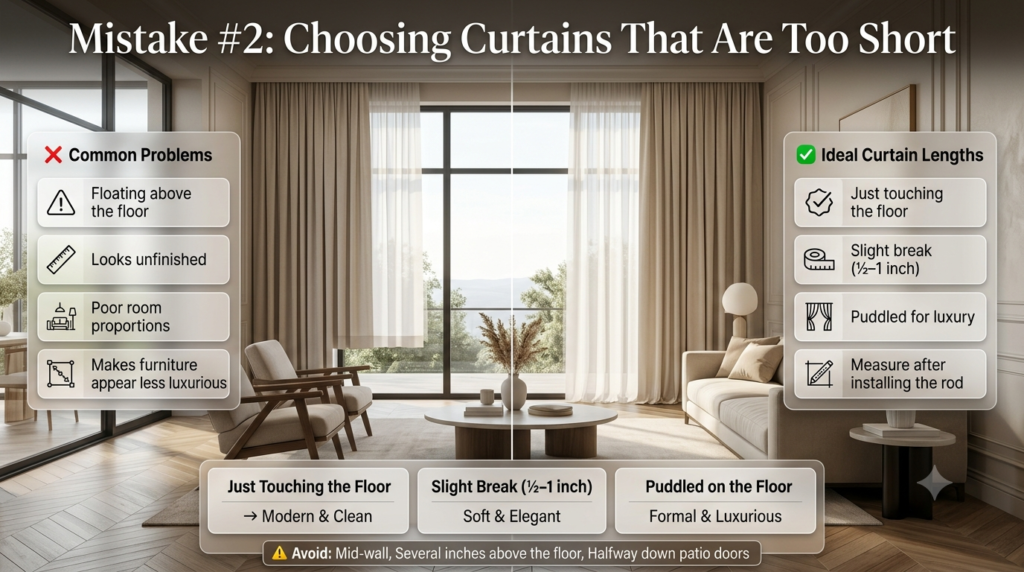
Curtains that stop several inches above the floor often make a room feel unfinished. Floor-length curtains create cleaner lines, improve proportions, and give interiors a more elegant, custom-made appearance.
Curtain length has a huge effect on how polished a room looks.
Many homeowners buy ready-made curtains without measuring their windows carefully. As a result, the fabric “floats” awkwardly above the floor.
This is one of the fastest ways to make expensive furniture appear less luxurious.
Ideal Curtain Lengths
Professional decorators usually recommend one of these styles:
| Style | Appearance |
|---|---|
| Just touching the floor | Modern and clean |
| Slight break (½–1 inch) | Soft and elegant |
| Puddled on the floor | Formal and luxurious |
Avoid curtains that end:
- Mid-wall
- Several inches above the floor
- Halfway down patio doors
These lengths interrupt the room’s vertical flow.
⭐ Expert Tip: Always measure after installing the curtain rod—not before. Rod height changes the required curtain length.
Mistake #3: Buying Curtains That Are Too Narrow
Curtains should look full even when closed. Panels that barely cover the window appear flat and inexpensive. Most designers recommend curtain widths equal to two to three times the width of the window for a richer, more luxurious appearance.
Fabric fullness makes an enormous difference.
Many people purchase curtain panels that exactly match the window width.
The result?
When closed, the curtains become stretched and flat with almost no folds.
Luxury interiors rarely use tight, flat curtains.
Compare the Difference
| Narrow Curtains | Properly Full Curtains |
|---|---|
| Flat appearance | Rich folds |
| Cheap look | Elegant texture |
| Less privacy | Better coverage |
| Minimal visual impact | Luxurious finish |
A fuller curtain creates:
- Better texture
- Better insulation
- Softer lighting
- More visual interest
As a general guideline:
Total curtain width = 2–3× the window width
This extra fabric creates the deep folds often seen in professionally designed homes.
Mistake #4: Using the Wrong Fabric for the Room
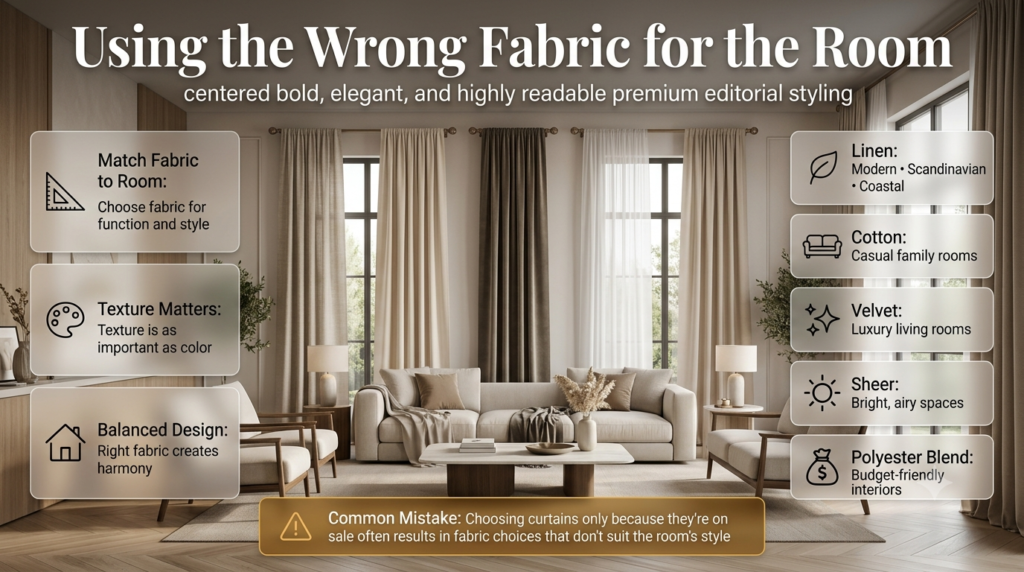
The wrong curtain fabric can disrupt a room’s style and functionality. Heavy fabrics overwhelm small rooms, while thin fabrics may look too casual in formal spaces. Choosing fabric based on the room’s purpose creates a balanced and cohesive design.
Not every curtain fabric works in every room.
One of the biggest decorating mistakes is choosing fabric based only on color.
Texture matters just as much.
Common Curtain Fabrics
| Fabric | Best For |
|---|---|
| Linen | Modern, Scandinavian, Coastal |
| Cotton | Casual family rooms |
| Velvet | Luxury living rooms |
| Sheer | Bright spaces |
| Polyester Blend | Budget-friendly interiors |
Heavy velvet in a tiny bedroom can feel overwhelming.
Very thin polyester in a grand dining room may appear inexpensive.
Instead, match the curtain material to both the room and your decorating style.
For more inspiration on matching textures and materials throughout your home, browse our Interior Design ideas.
⚠ Common Mistake: Choosing curtains solely because they’re on sale often leads to style mismatches that are more expensive to fix later.
Mistake #5: Ignoring Curtain Color and Room Harmony
Curtain color should complement the room rather than compete with it. Choosing colors that clash with walls, flooring, or furniture creates visual imbalance, while coordinated tones make the space feel professionally designed.
Curtains occupy a large amount of visual space.
Because of that, their color has a significant influence on how the entire room feels.
Many homeowners choose curtains as an afterthought.
Instead, designers treat them as one of the room’s primary design elements.
Safe Color Combinations That Always Look Expensive
| Wall Color | Curtain Color | Accent Material |
|---|---|---|
| White | Warm Beige | Oak Wood |
| Light Gray | Charcoal | Walnut |
| Soft Taupe | Cream | Brass |
| Sage Green | Beige | Natural Wood |
| Greige | Off White | Matte Black |
Neutral palettes remain popular because they:
- Age well.
- Match changing décor.
- Reflect natural light.
- Create a calm atmosphere.
That doesn’t mean bold colors are wrong—but they should be intentional and balanced with the rest of the room.
📌 Quick Tip: If you’re unsure which curtain color to choose, match the curtains to the room’s largest furniture piece rather than the wall. This often creates a more cohesive, designer-inspired look.
Mistake #6: Choosing Cheap Curtain Hardware
Curtain rods, rings, brackets, and finials are part of the overall design. Thin, flimsy hardware can make even premium curtains look inexpensive, while sturdy, well-finished hardware enhances the room’s style and provides better long-term durability.
Many people spend hundreds of dollars on beautiful curtains but overlook the hardware that supports them.
Think of curtain hardware as the finishing touch. Just as quality cabinet handles elevate a kitchen, well-chosen rods and brackets elevate your windows.
Signs of Low-Quality Curtain Hardware
- Thin metal rods that bend easily
- Plastic finials with a glossy finish
- Weak brackets that sag over time
- Mismatched hardware finishes
- Visible installation gaps
What Designers Prefer
Choose hardware that complements the room’s style:
| Interior Style | Recommended Hardware |
|---|---|
| Modern | Matte Black |
| Contemporary | Brushed Nickel |
| Traditional | Antique Bronze |
| Luxury | Satin Brass |
| Minimalist | Slim Black Steel |
The finish should coordinate with nearby elements such as light fixtures, cabinet handles, or furniture legs. This small detail creates a more intentional and cohesive look.
Coming Up in Part 2
In the next part, we’ll cover even more expensive-looking curtain upgrades, including:
- Mistake #7–#15 that homeowners often overlook
- How to layer curtains like a professional designer
- Step-by-step guide to choosing the perfect curtains
- Curtain styles for every room
- Designer comparison tables
- More expert tips and common mistakes
- Natural internal links to related Home Decor content
Mistake #7: Forgetting to Layer Curtains
Layering curtains combines functionality with style. A sheer layer filters daylight while blackout or heavier curtains provide privacy and light control. This designer technique adds depth, texture, and a luxurious appearance that single-layer curtains often can’t achieve.
One of the easiest ways to make windows look expensive is by using two layers of curtains instead of one.
Luxury homes, boutique hotels, and professionally designed interiors often combine sheer curtains with heavier drapes. The result is a room that feels more sophisticated and practical.
Benefits of Layered Curtains
- Better privacy during the day and night
- Improved light control
- Enhanced insulation
- Richer visual depth
- More flexibility for different times of the day
A Simple Layering Formula
Window
│
├── Sheer Curtain (closest to glass)
│
└── Decorative or Blackout Curtain (front layer)
This setup allows natural daylight to enter while maintaining privacy, then provides complete darkness when needed.
💡 Pro Tip: Choose sheers in white or off-white. Neutral sheers blend with almost every decorating style and make rooms feel brighter.
Mistake #8: Using the Same Curtains in Every Room
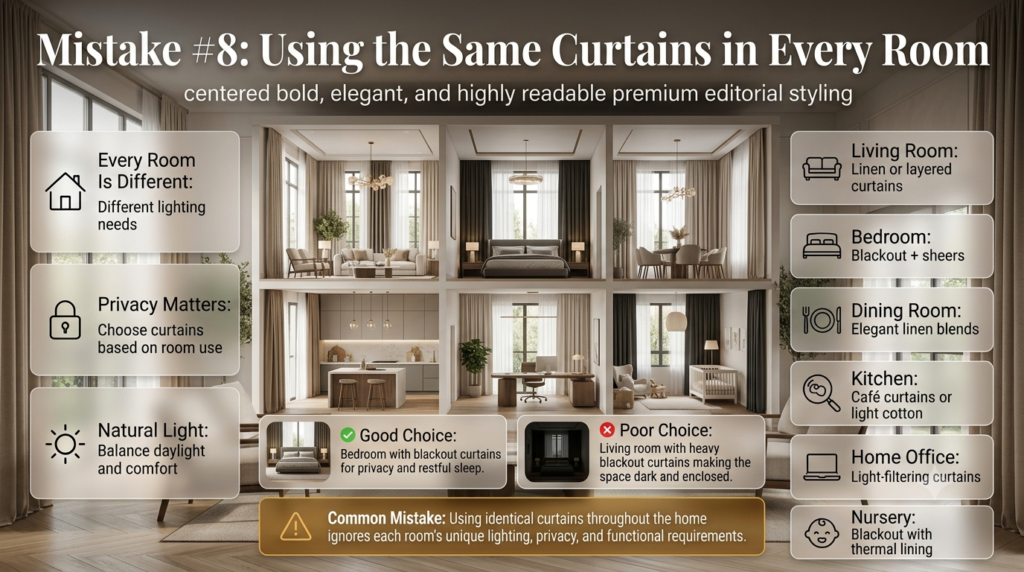
Different rooms have different lighting, privacy, and design needs. Using identical curtains throughout the home often ignores functionality. Selecting curtains based on each room’s purpose creates a more comfortable and visually balanced interior.
Many homeowners buy one curtain style and install it throughout the entire house.
Although this seems like an easy way to create consistency, it often has the opposite effect.
Each room serves a different purpose.
Best Curtain Choices by Room
| Room | Recommended Curtains |
|---|---|
| Living Room | Linen or layered curtains |
| Bedroom | Blackout curtains with sheers |
| Dining Room | Elegant linen blends |
| Kitchen | Café curtains or light cotton |
| Home Office | Light-filtering curtains |
| Nursery | Blackout with thermal lining |
For example:
A blackout curtain works beautifully in a bedroom but can make a sunny living room feel dark and closed in.
Likewise, sheer curtains may look stunning in a lounge but provide very little privacy in a bedroom.
Explore more decorating inspiration in our Home Decor section to coordinate each room beautifully.
Mistake #9: Choosing Busy Patterns That Overwhelm the Space
Large, busy curtain patterns can dominate a room and make it feel cluttered. Simple textures, timeless prints, or subtle patterns usually create a more elegant and versatile design that won’t quickly go out of style.
Curtains cover a large visual area.
That means oversized floral prints, bold geometric designs, or bright contrasting colors can easily become overwhelming.
This doesn’t mean patterned curtains are always wrong.
The key is balance.
When Patterns Work Best
Choose patterned curtains when:
- Walls are neutral.
- Furniture is simple.
- Decorative accessories are minimal.
- The room needs a focal point.
Avoid bold curtains if your room already contains:
- Patterned rugs
- Printed wallpaper
- Colorful artwork
- Busy furniture fabrics
⚠ Common Mistake: Combining patterned wallpaper, patterned furniture, and patterned curtains often creates visual clutter instead of visual interest.
Mistake #10: Ignoring Natural Light
Curtains should enhance natural light rather than block it unnecessarily. Selecting the right fabric, color, and placement helps brighten a room while still providing privacy and comfort.
Natural light makes rooms feel:
- Larger
- Cleaner
- Warmer
- More welcoming
Unfortunately, heavy or dark curtains can block sunlight throughout the day.
Instead, consider:
- Light-colored fabrics
- Sheer inner layers
- Wider curtain rods that allow curtains to stack outside the window
Designer Trick
Install curtain rods wider than the window.
This allows the curtains to sit beside the glass when open instead of covering it.
Result?
More daylight enters the room.
The window also appears larger.
Mistake #11: Choosing Curtains Without Measuring Properly
Incorrect measurements often lead to curtains that are too short, too narrow, or poorly fitted. Measuring the window, rod placement, and desired curtain length before shopping ensures a professional-looking result.
Guessing measurements is one of the biggest decorating mistakes.
Before buying curtains, measure:
- Window width
- Window height
- Desired rod height
- Distance from rod to floor
Measurement Checklist
✔ Measure twice.
✔ Decide rod placement first.
✔ Calculate curtain fullness.
✔ Consider puddling or floor-touching styles.
✔ Check whether curtain rings affect length.
📌 Quick Tip: Always buy curtains after installing—or at least deciding on—the curtain rod location.
Step-by-Step Guide to Choosing the Perfect Curtains
Choosing curtains becomes much easier when you follow a simple process instead of buying based on appearance alone.
Step 1: Identify the Room’s Purpose
Ask yourself:
- Is privacy important?
- Does the room receive strong sunlight?
- Is this a relaxing space?
- Is insulation needed?
For example:
Bedrooms usually benefit from blackout curtains.
Living rooms often work best with layered curtains.
Step 2: Measure Correctly
Measure:
- Width
- Height
- Ceiling height
- Rod width
Never rely on standard curtain sizes without checking your own windows.
Step 3: Choose the Right Fabric
Think about:
- Light control
- Maintenance
- Texture
- Style
A busy family home may benefit from washable cotton blends, while a formal dining room can support richer materials such as linen or velvet.
Step 4: Pick the Right Color
Instead of asking,
“What curtain color looks nice?”
Ask,
“What curtain color completes this room?”
Designers usually match curtains with one of these:
- Sofa
- Area rug
- Accent chair
- Decorative pillows
This creates harmony without making the room feel too coordinated.
Step 5: Select Quality Hardware
Quality rods, brackets, and rings improve both appearance and durability.
Small hardware upgrades often produce surprisingly dramatic results.
⭐ Expert Tip: Investing in better curtain hardware usually provides more visual impact than spending extra on decorative accessories.
Curtain Style Comparison
| Style | Best For | Pros | Cons |
|---|---|---|---|
| Sheer | Bright rooms | Soft light | Limited privacy |
| Blackout | Bedrooms | Excellent light control | Can feel heavy |
| Linen | Modern homes | Natural texture | Wrinkles easily |
| Velvet | Luxury interiors | Rich appearance | Higher maintenance |
| Cotton | Everyday use | Affordable and versatile | Less formal |
| Layered | Most rooms | Flexible and elegant | Slightly higher cost |
Designer Secrets That Instantly Make Curtains Look Expensive
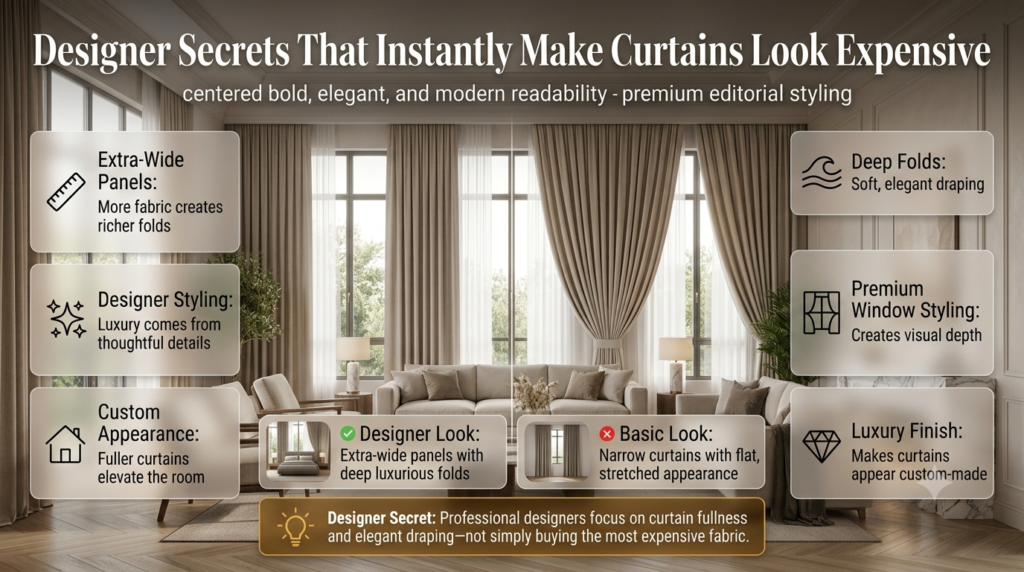
Professional interior designers don’t necessarily buy the most expensive curtains.
Instead, they focus on details.
Here are some of their favorite tricks:
Use Extra-Wide Curtain Panels
More fabric means deeper folds.
Deeper folds always appear more luxurious.
Steam Curtains Before Hanging
Freshly unpacked curtains usually have visible creases.
Steaming them immediately creates a crisp, custom-made appearance.
Match Metal Finishes
Coordinate curtain rods with:
- Door handles
- Cabinet hardware
- Light fixtures
- Furniture legs
This subtle consistency makes the room feel intentionally designed.
Let Curtains Frame the Window
Avoid covering too much glass.
Instead, install wider rods so curtains frame the window instead of blocking it.
Keep Hemlines Consistent
If multiple windows are visible in the same room, maintain the same curtain length throughout.
Consistency makes the room feel organized and professionally styled.
Common Beginner Curtain Mistakes
Even with good intentions, beginners often make the same decorating errors.
| Mistake | Why It Happens | Better Solution |
|---|---|---|
| Buying before measuring | Saves time | Measure first |
| Choosing style over function | Focus on appearance | Balance beauty and practicality |
| Ignoring room lighting | Overlooks daily use | Consider sunlight direction |
| Matching curtains exactly to walls | Fear of contrast | Use complementary tones |
| Buying the cheapest option | Budget concerns | Prioritize quality fabric and hardware |
| Forgetting maintenance | Looks only at style | Choose washable fabrics where practical |
These mistakes are easy to avoid with a little planning—and fixing them can dramatically improve the overall look of your home.
For even more decorating ideas that work beautifully with stylish window treatments, check out our Furniture and Home Improvement Tips guides.
Room-by-Room Curtain Checklist
Before buying curtains, ask yourself:
✔ Living Room
- Plenty of natural light?
- Layered curtains?
- Neutral color palette?
- Wide enough panels?
✔ Bedroom
- Blackout needed?
- Floor-length curtains?
- Soft textures?
- Privacy covered?
✔ Dining Room
- Elegant fabric?
- Coordinated hardware?
- Balanced color?
✔ Kitchen
- Easy-to-clean material?
- Moisture-resistant fabric?
- Plenty of daylight?
Completing this checklist helps ensure your curtains enhance each room instead of becoming a costly decorating mistake.
What is the ideal curtain height to make a room look expensive?
Most homeowners default to hanging curtain rods directly above the window frame. This is a critical mistake that shrinks your space. To create an high-end, custom look, you need to trick the eye into seeing taller ceilings. Professional designers use the “high and wide” technique.
Mount your curtain rod 4 to 6 inches below the ceiling line, or at least 8 to 12 inches above the window frame. Combined with this, the fabric must actually reach the floor. Curtains that stop short—often called “flooders”—instantly make a room look cheap and unfinished.
The Rule: Hang rods closer to the ceiling than the window frame.
The Length: Fabric should kiss the floor or puddle slightly (1-2 inches).
The Illusion: Vertically elongates the room, making standard ceilings feel majestic.
How wide should curtain rods extend past the window frame?
Buying a rod that matches the exact width of your window is a recipe for a cramped, dark room. When you open your curtains, the fabric will block the glass, cutting off natural light and making the window look significantly smaller than it is.
Extend your curtain rod 8 to 12 inches past the window frame on each side. This extra space allows the curtain panels to rest on the actual wall when fully open. It maximizes the amount of daylight entering your home and gives the illusion of massive, expansive windows.
The Extension: Extend rods 8–12 inches beyond the frame on both sides.
The Benefit: Keeps the entire glass pane clear when curtains are open.
The Result: Makes narrow windows look double their actual size.
Why do my curtains look thin and cheap, and how do I fix the fullness?
A major giveaway of store-bought, low-budget drapery is a flat, skimpy appearance when the curtains are closed. If you only buy enough panels to barely cover the width of the window, they will stretch tight like a bedsheet, losing all luxury appeal.
To get that rich, gathered look, your total curtain width should be 2 to 2.5 times the width of the window itself. If your window is 50 inches wide, you need at least 100 to 125 inches of fabric width split between your panels. Additionally, avoid lightweight, unlined synthetic fabrics that look translucent in the sun. The Multiplier: Total panel width must equal 2x or 2.5x the window width.
The Weight: Opt for heavy cotton, linen blends, or velvet.
The Secret: Always choose lined curtains to block light and add structured weight.
What hanging style or header type looks the most premium?
Grommet curtains—the ones with large metal rings stamped directly into the fabric—are incredibly common, but they rarely look high-end. They tend to look casual, stiff, and distinctly mass-produced.
For a sophisticated, tailored aesthetic, look for back-tab, pinch-pleat, or Euro-pleat headers. If you are on a budget, you can use drapery rings with clips attached to flat panels. This elevates the curtains off the rod, allows them to hang more naturally, and mimics the look of expensive, custom-made track systems.
Avoid: Heavy reliance on grommet tops or basic rod pockets.
Embrace: Pinch pleats, tailored pleats, or hanging rings.
The Motion: Rings allow the fabric to glide smoothly and drape in clean uniform folds.
How do iron-on hem tapes and steaming impact the final look?
You can buy the most expensive linen curtains on the market, but if they are covered in packaging creases or dragging roughly on the floor, they will look cheap. Neglecting the final presentation details ruins the entire investment.
Wrinkles catch the light awkwardly and make your space look messy. Investing a few minutes into steaming your panels once they are hung is non-negotiable. Furthermore, if your curtains are too long, do not let them bunch up awkwardly like a crumpled blanket. Use iron-on adhesive hem tape for a quick, seamless, no-sew custom adjustment.
The Finish: Never leave packing wrinkles; steam panels directly on the rod.
The Tailoring: Use iron-on hem tape to get the exact length without sewing.
The Maintenance: “Train” your curtains by gathering them into clean folds and tying them loosely for a few days to set their shape.
Conclusion
Curtains do much more than cover windows—they shape the way a room looks, feels, and functions. Even if you’ve invested in quality furniture and beautiful décor, common curtain mistakes can make your home appear smaller, outdated, or less polished than it deserves.
The good news is that most of these mistakes are easy to fix. Hanging curtain rods higher, choosing floor-length panels, selecting the right fabric and color, using quality hardware, and ensuring proper curtain width can instantly transform the look of any room. These simple changes create a cleaner, more balanced design that feels both stylish and welcoming.
Remember, achieving a designer-inspired home isn’t about spending the most money—it’s about making thoughtful design choices. By avoiding the Curtain Mistakes That Make Your Home Look Cheap and following timeless decorating principles, you can create a space that looks elegant, feels comfortable, and reflects your personal style.
Before buying your next set of curtains, take a few extra minutes to measure carefully, consider your room’s needs, and focus on quality over trends. Those small decisions will have a lasting impact, helping your home look more refined, more cohesive, and far more expensive than its actual budget.