
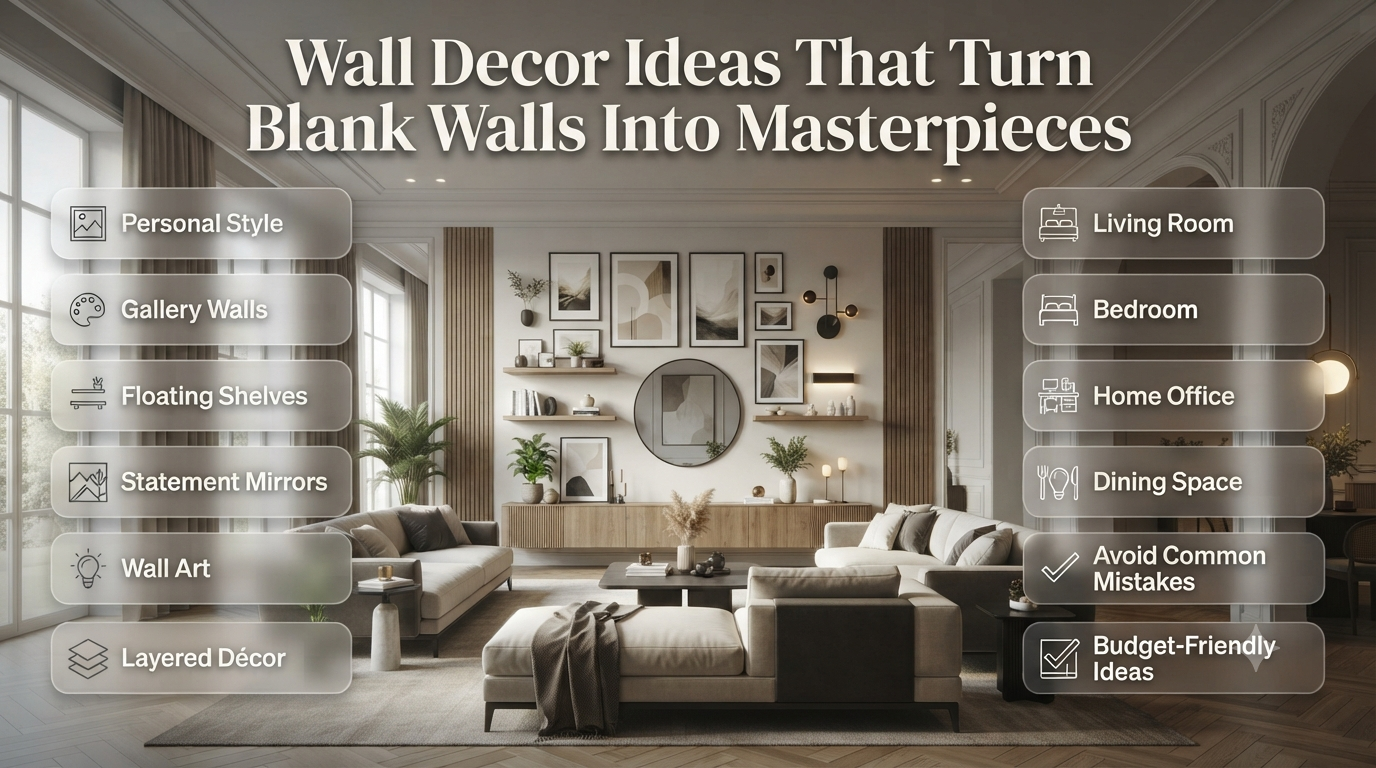
Blank walls can make even a beautifully furnished home feel unfinished. You may have the perfect sofa, stylish lighting, and elegant flooring, but if your walls are empty, the entire room can lack warmth and personality. The good news is that transforming plain walls doesn’t always require a complete renovation or a huge budget.
These Wall Decor Ideas That Turn Blank Walls Into Masterpieces will help you create stunning interiors that reflect your personality while making every room feel complete. Whether you’re decorating a living room, bedroom, hallway, home office, or dining space, you’ll discover practical ideas that fit every style—from modern minimalism to cozy farmhouse décor.
In this guide, you’ll learn how to choose the right wall décor, avoid common decorating mistakes, combine different decorative elements, and create walls that become the focal point of your home.
If you’re also planning a complete room makeover, explore our Room Design ideas for more inspiration.
Why Wall Decor Matters More Than Most Homeowners Think
Wall décor adds personality, balance, color, and visual interest to a room. Properly decorated walls make spaces feel larger, more inviting, and professionally designed while reflecting the homeowner’s style.
Many people spend thousands on furniture but leave their walls untouched. Interior designers know that walls act as the backdrop for everything else inside a room. When decorated thoughtfully, they tie together colors, textures, and furniture into one cohesive design.
Well-designed walls can:
- Make small rooms feel larger
- Add warmth to modern interiors
- Highlight architectural features
- Create conversation pieces
- Improve visual balance
- Reflect your personality
- Increase perceived home value
Think of wall décor as the finishing touch that completes your home’s story.
💡 Pro Tip: Before buying any wall décor, stand at your room’s entrance and identify the first wall your eyes naturally notice. That’s usually the best place for a statement feature.
How to Choose the Right Wall Decor for Any Room
The best wall décor depends on your room’s size, lighting, furniture style, color palette, and purpose. Choose pieces that complement—not compete with—your existing décor.
Instead of buying decorations simply because they’re trendy, ask yourself a few questions:
- What feeling do I want this room to create?
- Is the room bright or dark?
- Do I want one focal point or several smaller features?
- Does the room already have bold furniture?
- How much wall space is available?
When you answer these questions first, decorating becomes much easier.
Consider Room Function
Different rooms have different needs.
| Room | Best Wall Decor Ideas |
|---|---|
| Living Room | Gallery walls, oversized art, floating shelves |
| Bedroom | Soft artwork, mirrors, fabric panels |
| Dining Room | Statement mirrors, elegant frames |
| Home Office | Motivational prints, shelving, pegboards |
| Entryway | Mirrors, family photos, welcome signs |
| Hallway | Photo collections, wall lighting |
Start with a Focal Point
Professional designers rarely decorate every wall equally.
Instead, they create one “hero wall.”
This becomes the visual centerpiece of the room.
Examples include:
- Large canvas artwork
- Wood accent wall
- Oversized mirror
- Wallpaper feature wall
- Built-in shelving
- Vertical garden
Everything else should support—not overpower—that focal point.
⭐ Expert Tip: If you don’t know where to begin, decorate only one wall first. A single well-designed wall often looks better than four overcrowded ones.
Best Wall Decor Ideas That Turn Blank Walls Into Masterpieces
Let’s explore the most effective decorating ideas used by interior designers.
1. Create a Gallery Wall
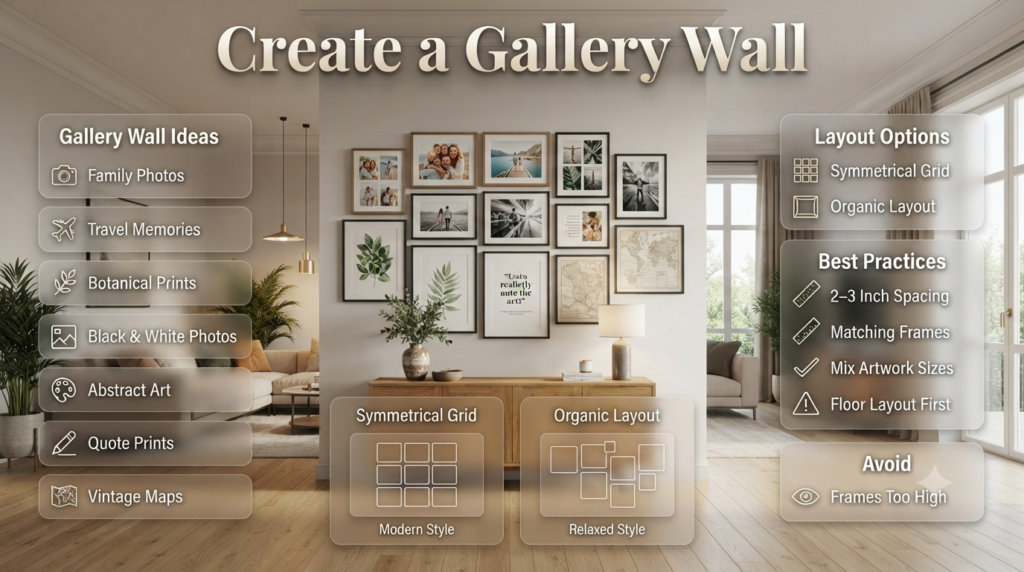
A gallery wall combines artwork, photos, prints, and decorative objects into one organized display that adds personality and visual interest.
Gallery walls remain one of the most versatile decorating techniques because they can be customized for every home.
Popular gallery wall combinations include:
- Family photographs
- Travel memories
- Botanical prints
- Black-and-white photography
- Abstract paintings
- Inspirational quotes
- Vintage maps
Layout Options
Symmetrical Grid

□ □ □
□ □ □
□ □ □
Perfect for modern homes.
Organic Layout

□   □
   □
□     □
    □
Ideal for relaxed interiors.
Best Practices
- Keep spacing between 2–3 inches.
- Use matching frame colors for consistency.
- Mix artwork sizes carefully.
- Lay everything on the floor first before hanging.
⚠ Common Mistake: Hanging frames too high. Artwork usually looks best when its center sits approximately at eye level.
2. Oversized Statement Art
Large artwork instantly changes how a room feels.
Instead of filling a wall with many small decorations, one oversized piece creates elegance with less visual clutter.
Great choices include:
- Modern abstract paintings
- Nature landscapes
- City skylines
- Ocean photography
- Minimalist line art
- Large black-and-white prints
Oversized art works especially well above:
- Sofas
- Beds
- Dining tables
- Fireplace mantels
- Entryway consoles
The artwork should generally be about two-thirds the width of the furniture beneath it.
📌 Quick Tip: One large canvas often costs less than buying several smaller decorative pieces.
3. Floating Shelves That Blend Beauty and Function
Floating shelves provide decoration and storage at the same time.
Unlike traditional shelves, they appear to “float,” creating a clean, modern appearance.
You can style them with:
- Small plants
- Candles
- Books
- Ceramic vases
- Sculptures
- Framed photos
- Decorative baskets
A balanced shelf usually mixes:
- Tall objects
- Short objects
- Natural textures
- Empty space
Don’t feel pressured to fill every inch.
Negative space actually makes shelves look more sophisticated.
If you enjoy practical decorating ideas, visit our Home Decor section for additional inspiration.
4. Decorative Mirrors That Expand a Room
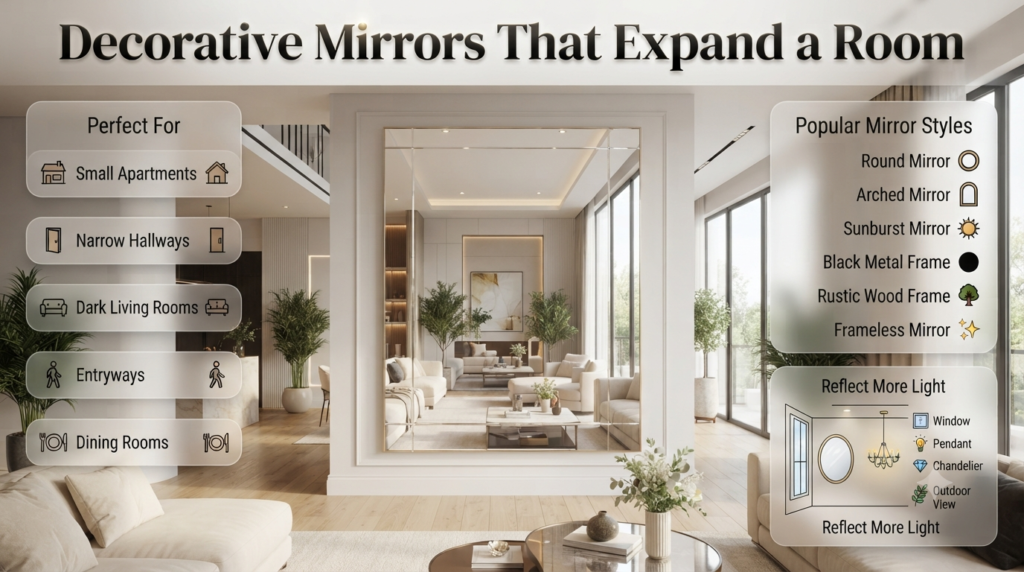
Mirrors reflect both light and space, making rooms appear brighter and larger while adding elegance to blank walls.
Mirrors work especially well in:
- Small apartments
- Narrow hallways
- Dark living rooms
- Entryways
- Dining rooms
Popular mirror styles include:
- Round mirrors
- Arched mirrors
- Sunburst mirrors
- Black metal frames
- Rustic wooden frames
- Frameless contemporary mirrors
Mirror Placement Tips
Place mirrors opposite:
- Windows
- Pendant lighting
- Chandeliers
- Beautiful outdoor views
This maximizes reflected light throughout the room.
5. Accent Walls Using Wallpaper
Wallpaper has made a huge comeback.
Modern peel-and-stick wallpaper allows homeowners to completely transform a room without permanent changes.
Popular wallpaper patterns include:
- Botanical leaves
- Marble textures
- Geometric designs
- Neutral linen effects
- Floral patterns
- Tropical prints
- Vintage textures
Accent walls work best behind:
- Beds
- TVs
- Sofas
- Dining tables
- Home office desks
Because only one wall is covered, the room remains balanced rather than overwhelming.
6. Wood Slat Walls for a Luxury Look
Wood slat panels have become one of today’s most sought-after wall design trends.
They introduce warmth, texture, and architectural depth while maintaining a minimalist appearance.
Benefits include:
- Adds texture
- Improves acoustics
- Creates visual height
- Works with modern interiors
- Pairs beautifully with LED lighting
Wood slat walls are especially stunning in:
- Living rooms
- Bedrooms
- Home theaters
- Offices
If you’re planning a broader makeover, check out our Interior Design guides for complete room transformations.
Add a Living Wall with Indoor Plants
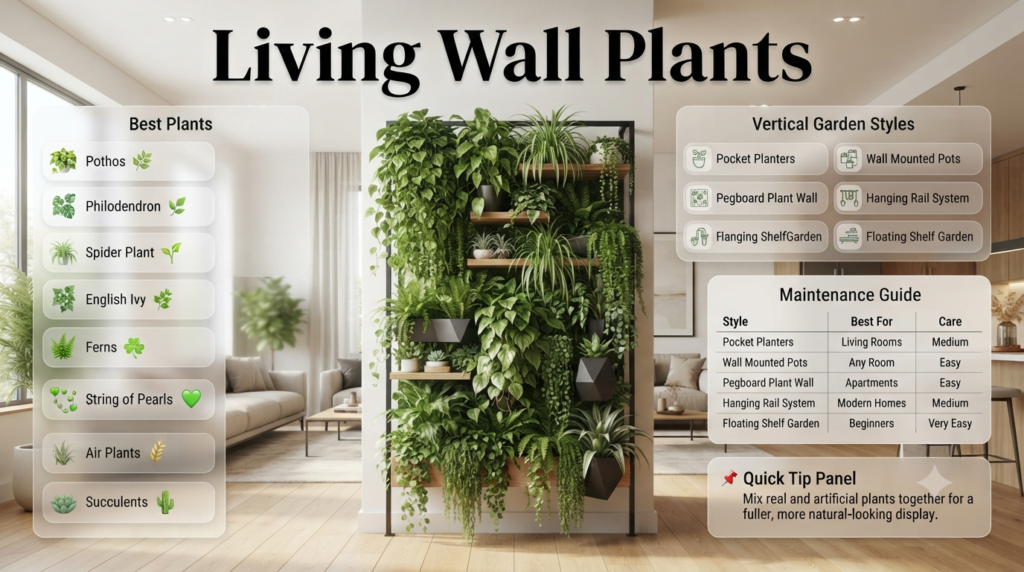
A living wall combines greenery with decorative design to transform plain walls into vibrant focal points. Vertical gardens improve aesthetics, soften hard surfaces, and create a calming atmosphere while taking up very little floor space.
If you love nature but don’t have space for large indoor plants, a vertical garden is one of the best wall decorating solutions.
Living walls instantly make a room feel fresh and welcoming.
Great Plants for Vertical Wall Displays
- Pothos
- Philodendron
- Spider Plant
- English Ivy
- Ferns
- String of Pearls
- Air Plants
- Succulents
Different Ways to Create One
| Style | Best For | Maintenance |
|---|---|---|
| Pocket Planters | Living Rooms | Medium |
| Wall Mounted Pots | Any Room | Easy |
| Pegboard Plant Wall | Apartments | Easy |
| Hanging Rail System | Modern Homes | Medium |
| Floating Shelf Garden | Beginners | Very Easy |
If your room doesn’t receive much sunlight, high-quality artificial plants can provide a similar visual effect with almost no maintenance.
📌 Quick Tip: Mix real and artificial plants together for a fuller, more natural-looking display.
8. Install Wall Molding and Decorative Paneling
Wall molding adds architectural detail and elegance to blank walls. It creates depth, visual texture, and a high-end appearance without requiring expensive renovations.
Decorative molding works in almost every decorating style.
Popular choices include:
- Picture frame molding
- Board and batten
- Wainscoting
- Raised panels
- Shiplap
- Beadboard
Which Style Fits Your Home?
| Design Style | Recommended Paneling |
|---|---|
| Modern | Thin square molding |
| Farmhouse | Shiplap |
| Traditional | Raised panels |
| Scandinavian | Simple vertical trim |
| Luxury | Full wall panel molding |
Painting the molding the same color as the wall creates subtle texture.
Painting it in a contrasting color creates dramatic impact.
⭐ Expert Tip: Even inexpensive MDF molding can look custom-made after proper painting and caulking.
9. Use Decorative Wall Lighting
Lighting isn’t just functional.
It can become part of your wall design.
Decorative lighting adds depth, highlights artwork, and creates a cozy mood.
Popular wall lighting includes:
- Wall sconces
- Picture lights
- LED strip lighting
- Smart RGB lighting
- Industrial wall lamps
- Brass reading lights
Wall lighting works especially well beside:
- Beds
- Mirrors
- Artwork
- Fireplace mantels
- Hallways
Instead of relying only on ceiling lights, layered lighting creates a more comfortable atmosphere.
10. Display Personal Collections
Your home should tell your story.
Displaying meaningful collections turns empty walls into conversation starters.
Ideas include:
- Vintage cameras
- Vinyl records
- Travel souvenirs
- Hats
- Woven baskets
- Decorative plates
- Musical instruments
- Antique clocks
The key is organization.
Arrange similar items together rather than scattering them throughout the room.
The result feels intentional instead of cluttered.
11. Add Texture with Woven Wall Hangings
Texture makes interiors feel richer.
Fabric wall décor softens hard surfaces and adds warmth.
Popular options include:
- Macramé
- Woven tapestries
- Handmade rugs
- Cotton wall hangings
- Boho textiles
- Handmade fiber art
These work particularly well in:
- Bedrooms
- Reading corners
- Nursery rooms
- Scandinavian interiors
- Bohemian homes
Textiles also help reduce echoes in larger rooms.
12. Create a Functional Pegboard Wall
Pegboards aren’t only for garages anymore.
Modern pegboard systems combine organization with design.
They’re perfect for:
- Home offices
- Craft rooms
- Kitchens
- Entryways
You can hang:
- Plants
- Shelves
- Office supplies
- Keys
- Small baskets
- Decorative accessories
Everything stays organized while becoming part of the décor.
13. Use Large Clocks as Statement Pieces
Oversized wall clocks blend function with style.
Popular materials include:
- Wood
- Iron
- Brass
- Matte black steel
- Mixed metal finishes
Large clocks work best on wide walls where artwork alone might feel too small.
14. Install Open Wall Shelving
Unlike floating shelves, full open shelving systems create complete feature walls.
They’re ideal for displaying:
- Books
- Art
- Plants
- Decorative bowls
- Family photos
- Storage baskets
The trick is balance.
Alternate between decorative objects and empty space to avoid visual overload.
DIY Wall Decor Ideas on a Budget
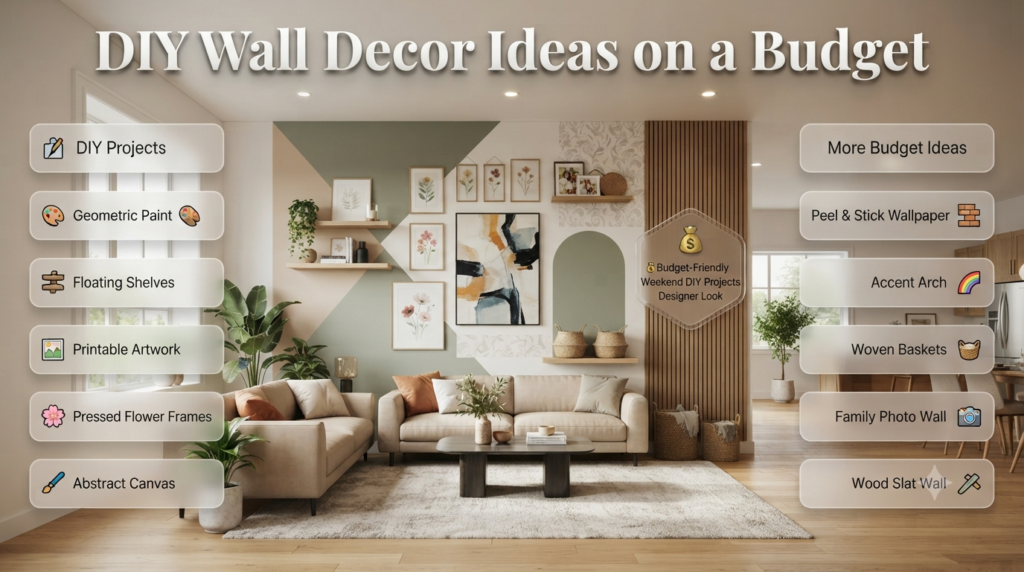
Beautiful walls don’t have to be expensive.
Many designer-inspired ideas can be completed over a weekend.
Affordable DIY Projects
- Paint geometric wall designs
- Build floating shelves
- Frame printable artwork
- Make pressed flower frames
- Create canvas abstract paintings
- Install peel-and-stick wallpaper
- Paint an accent arch
- Hang woven baskets
- Create a family photo wall
- Build a wood slat feature wall
Many of these projects cost less than buying a single piece of premium artwork.
If you enjoy hands-on decorating projects, explore our DIY Crafts section.
Wall Decor Ideas by Room
Different rooms require different decorating approaches.
Living Room
Best choices include:
- Oversized artwork
- Gallery walls
- Floating shelves
- Accent lighting
- Decorative mirrors
The goal is creating an inviting focal point.
Bedroom
Choose calming décor such as:
- Soft artwork
- Fabric wall hangings
- Wooden panels
- Minimalist frames
- Neutral wallpaper
Avoid overly busy patterns that may disrupt relaxation.
Dining Room
Elegant options include:
- Statement mirrors
- Modern artwork
- Wall molding
- Decorative sconces
Keep decorations sophisticated without overwhelming the dining experience.
Home Office
Boost productivity with:
- Inspirational prints
- Pegboards
- Floating shelves
- Vision boards
- Minimalist artwork
A clean workspace often improves focus.
Entryway
Make a memorable first impression.
Try:
- Round mirrors
- Welcome signs
- Narrow shelves
- Wall hooks
- Family photos
Entryways don’t need much space to make a strong visual impact.
Choosing Wall Decor Based on Interior Style
| Interior Style | Recommended Wall Decor |
|---|---|
| Modern | Large abstract art, black frames, minimal shelves |
| Scandinavian | Neutral prints, wood accents, woven décor |
| Farmhouse | Rustic signs, reclaimed wood, vintage clocks |
| Industrial | Metal artwork, exposed shelving, black frames |
| Traditional | Framed paintings, molding, mirrors |
| Bohemian | Macramé, baskets, plants, colorful textiles |
| Coastal | Ocean prints, driftwood, woven mirrors |
| Minimalist | One large artwork, clean lines, subtle colors |
How Color Affects Wall Decor
Wall color influences how decorations appear.
Light Walls
Perfect with:
- Black frames
- Wood accents
- Bright artwork
- Green plants
Dark Walls
Look stunning with:
- Gold frames
- Brass lighting
- White artwork
- Oversized mirrors
Neutral Walls
Offer maximum decorating flexibility.
You can easily change accessories without repainting.
⚠ Common Mistake: Buying wall décor before selecting your room’s color palette often leads to mismatched interiors.
Wall Decor Trends for 2026
Interior designers are embracing timeless styles over short-lived trends.
Popular trends include:
- Curved mirrors
- Organic shapes
- Earth-tone artwork
- Textured wall panels
- Sustainable materials
- Handmade décor
- Oversized canvas art
- Mixed natural wood finishes
- Limewash accent walls
- Sculptural wall lighting
The best trend is one that matches your personal style rather than following every new design craze.
Common Wall Decorating Mistakes (And How to Avoid Them)
Even expensive wall décor can look out of place if it’s used incorrectly. The most beautiful rooms usually follow a few simple design principles rather than relying on costly decorations.
1. Hanging Artwork Too High
This is one of the most common decorating mistakes.
Artwork should generally be hung so that its center sits around eye level (about 57–60 inches from the floor). When placed too high, it feels disconnected from the furniture below.
Better approach: If hanging art above a sofa or console table, leave approximately 6–10 inches of space between the furniture and the artwork.
2. Choosing Décor That’s Too Small
A tiny picture on a large wall often looks lost.
Instead of using one small frame, consider:
- A large canvas
- A gallery wall
- Three coordinated prints
- Floating shelves with décor
Larger walls usually need larger design elements to create balance.
3. Overcrowding the Wall
More isn’t always better.
Too many frames, shelves, mirrors, and decorations competing for attention can make a room feel chaotic.
A well-decorated wall includes negative space, giving the eye a place to rest.
⚠ Common Mistake: Filling every empty space. Sometimes leaving part of a wall blank creates a more elegant and balanced look.
4. Ignoring Scale and Proportion
Wall décor should complement the furniture beneath it.
For example:
| Furniture | Ideal Wall Décor Width |
|---|---|
| Sofa | 60–75% of sofa width |
| Bed Headboard | Similar to headboard width |
| Dining Buffet | Slightly narrower than buffet |
| Console Table | Around two-thirds of table width |
Keeping proportions consistent creates a polished appearance.
5. Forgetting Lighting
Even beautiful artwork can disappear in a poorly lit room.
Use a combination of:
- Natural daylight
- Wall sconces
- Picture lights
- Accent lighting
Good lighting highlights textures, colors, and decorative details.
Step-by-Step Guide to Decorating a Blank Wall
If you’re unsure where to start, follow this simple process.
Step 1: Measure the Wall
Before shopping, measure:
- Width
- Height
- Ceiling height
- Furniture placement
Accurate measurements help you choose décor that fits properly.
Step 2: Decide on a Style
Ask yourself:
- Modern?
- Farmhouse?
- Scandinavian?
- Traditional?
- Industrial?
- Bohemian?
Sticking to one primary style creates a cohesive look.
Step 3: Select a Focal Point
Choose one feature to anchor the wall.
Examples include:
- Oversized artwork
- Decorative mirror
- Wood slat wall
- Gallery wall
- Wallpaper
- Large clock
Everything else should support this centerpiece.
Step 4: Add Layers
Professional designers rarely rely on a single decorative item.
Layer different elements, such as:
- Artwork
- Lighting
- Plants
- Shelves
- Decorative objects
- Textures
Layering adds depth without making the space feel cluttered.
Step 5: Review Before Hanging
Place frames on the floor first.
Try different layouts.
Take a photo with your phone.
You’ll often notice spacing or alignment issues before making holes in the wall.
⭐ Expert Tip: Cut paper templates matching your artwork sizes and tape them to the wall first. This lets you test layouts without committing.
Professional Designer Tips for Stunning Walls
Interior designers often follow a few simple habits that dramatically improve the final result.
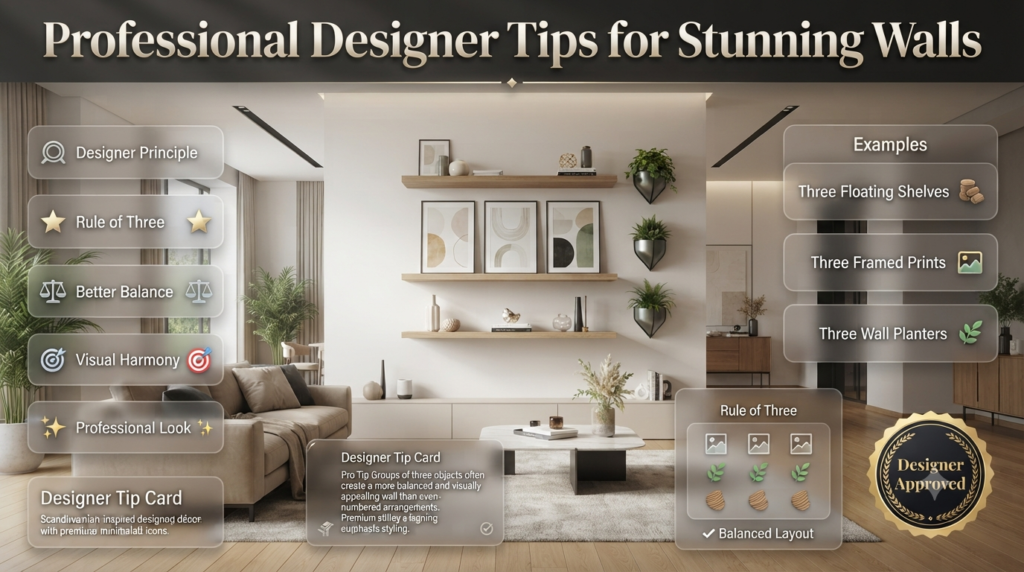
Use the Rule of Three
Decorating with groups of three objects usually feels more balanced than using even numbers.
Examples:
- Three floating shelves
- Three framed prints
- Three wall planters
Mix Materials
Combining different textures creates visual interest.
Try pairing:
- Wood
- Metal
- Glass
- Fabric
- Stone
- Greenery
This prevents the wall from looking flat or repetitive.
Repeat Colors
Repeat one or two accent colors from your furniture in your wall décor.
For example:
- Blue cushions → Blue artwork
- Wooden coffee table → Wooden frames
- Brass lamp → Brass mirror
Repeating colors ties the room together.
Leave Space to Breathe
Not every wall needs to be decorated.
Empty space helps highlight your focal points and keeps the room feeling open.
📌 Quick Tip: After finishing a wall, step back several feet. If your eyes don’t know where to focus, simplify the arrangement.
Quick Comparison: Popular Wall Decor Ideas
| Wall Decor Idea | Budget | Difficulty | Best For |
|---|---|---|---|
| Gallery Wall | $$ | Easy | Living rooms, hallways |
| Oversized Art | $$$ | Very Easy | Modern interiors |
| Floating Shelves | $$ | Medium | Any room |
| Mirrors | $$ | Easy | Small spaces |
| Wallpaper | $$ | Medium | Feature walls |
| Wood Slat Wall | $$$ | Medium | Luxury interiors |
| Wall Molding | $$ | Medium | Classic homes |
| Vertical Garden | $$ | Medium | Nature-inspired spaces |
| Macramé & Textiles | $ | Easy | Bedrooms, boho décor |
| Pegboard Wall | $ | Easy | Home offices |
How do I choose the right scale of artwork so it does not look lost on a large blank wall?
Scale is the single most critical factor in wall design. Homeowners often make the mistake of hanging a tiny frame on a massive accent wall, which instantly cheapens the room’s aesthetic. As a general rule of thumb in interior design, your wall decor should occupy roughly 60% to 75% of the available, unobstructed wall space. If you are hanging art above a piece of furniture like a sofa or a sideboard, the grouping or single piece of art should measure between two-thirds and three-quarters of the furniture’s total width to maintain visual balance.
The Oversized Approach: Use one massive, statement canvas to create a singular, minimalist focal point.
The Multi-Frame Solution: Group smaller frames tightly together to visually mimic one large design footprint.
The Negative Space Rule: Leave 3 to 6 inches of breathing room between the edges of your decor and adjacent walls or furniture.
What are the best damage-free wall decor options for renters who want a high-end look?
Renter-friendly design no longer means sacrificing luxury or settle for boring spaces. The modern market offers highly sophisticated temporary options that look identical to permanent architectural fixtures. The key to making renter-friendly decor look high-end lies in the texture; avoid flat vinyl decals and instead opt for materials with physical depth, reflection, or textile weight.
Peel-and-Stick Molding: Use lightweight, self-adhesive polyurethane trim to create classic Parisian wall panels.
Tapestries & Textiles: Hang heavy, woven rugs or linen tapestries using damage-free hook systems to add instant warmth.
Heavy-Duty Adhesive Strips: Utilise professional-grade hook-and-loop fasteners to mount large, lightweight frames without drilling.
How do I successfully mix and match different types of art on a single gallery wall?
The secret to a curated, designer-level gallery wall—rather than a chaotic mess—is establishing a cohesive visual anchor. You can mix mediums freely, combining oil paintings, black-and-white photography, and 3D objects, provided they share at least one unifying element. This common thread is typically either a strict, limited color palette or a uniform framing style.
The Color Anchor: Keep the art styles completely different but ensure every piece features a splash of a specific accent color.
The Frame Anchor: Use identical frames and matting styles to neatly package wildly diverse art mediums.
The Layout Strategy: Lay your entire collection on the floor first, starting with the largest piece in the center and building outward.
Are accent walls still on-trend, or should I decorate the entire room uniformly?
The traditional “brightly painted single accent wall” has evolved significantly. Today, modern interior design favors dimensional, tactile accent walls over flat, brightly colored paint. Instead of painting one wall red, designers are using wood paneling, plaster textures, or bold murals to create a specific zone within an open-concept layout. If you prefer a traditional flat paint color, it is now more fashionable to wrap all four walls in that shade to create an immersive, cozy atmosphere.
Dimensional Paneling: Use floor-to-ceiling wooden slats or board-and-batten to introduce architectural shadow lines.
Microcement & Plaster: Apply tactile, textured concrete washes to create an industrial or organic minimalist backdrop.
Zoning: Use a focused wall design specifically to define a functional area, like behind a bed headboard or a home office desk.
How can I incorporate lighting to make my wall decor look like a professional gallery?
Lighting is the ultimate tool that elevates average wall decor into a museum-worthy masterpiece. Even the most expensive art will look flat and uninspiring without proper illumination. Professional gallery styling utilizes layered lighting to create depth, eliminate harsh shadows, and accurately highlight the textures and colors of the artwork.
Art Track Lights: Install ceiling-mounted tracks with adjustable LED spotlights angled at precisely 30 degrees to avoid glare.
Cordless Picture Lights: Mount rechargeable, brass picture lights directly above your frames for a classic, high-end look without visible wires.
LED Backlighting: Place hidden LED light strips behind floating wall panels or mirrors to create a dramatic, glowing halo effect.
Conclusion
Blank walls are full of possibilities. Whether you choose a striking gallery wall, a timeless oversized mirror, elegant wood paneling, or a simple collection of floating shelves, the right design choices can completely transform the look and feel of your home.
The best wall décor isn’t necessarily the most expensive—it’s the décor that reflects your personality, complements your space, and creates a room you’ll enjoy spending time in every day. Start with one wall, focus on balance and proportion, and build your design gradually. With thoughtful planning and a few creative ideas, even the plainest wall can become a true masterpiece.
For more decorating inspiration, don’t forget to explore our Interior Design, Home Decor, Room Design, DIY Crafts, and Home Page for additional guides and ideas.